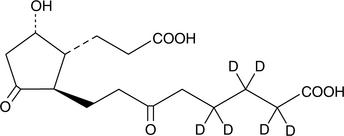
An internal standard for the quantification of tetranor-PGDM
Related Products
Unlabeled Version(s)
12850tetranor-PGDM
Technical Support & Resources

Visit our FAQ

Contact Us

Toll Free Phone (USA and Canada Only): (888) 526-5351
Direct Phone: (734) 975-3888

Request Technical Support

Technical Support Request

To streamline the process attach the appropriate questionnaire to your inquiry.

Download IHC QuestionnaireDownload WB Questionnaire

View Our Privacy Statement for details on how we use and protect your data. In addition, this site is protected by hCaptcha and its Privacy Policy and Terms of Service apply.

tetranor-PGDM-d6

Item No. 10009039

Technical Information
Formal Name
9α-hydroxy-11,15-dioxo-2,3,4,5-tetranor-prostan-1,20-dioic acid-17,17,18,18,19,19-d6
CAS Number
1314905-92-4
Synonyms
  • tetranor-Prostaglandin D Metabolite-d6
Molecular Formula
C16H18O7D6
Formula Weight
Purity
≥99% deuterated forms (d1-d6)
Formulation
A 100 µg/ml solution in methyl acetate
DMF: 50 mg/mlDMSO: 50 mg/mlEthanol: Not stablePBS (pH 7.2): 1 mg/ml
SMILES
O[C@@H](C1)[C@H](CCC(O)=O)[C@@H](CCC(CC([2H])([2H])C([2H])([2H])C([2H])([2H])C(O)=O)=O)C1=O
InChi Code
InChI=1S/C16H24O7/c17-10(3-1-2-4-15(20)21)5-6-11-12(7-8-16(22)23)14(19)9-13(11)18/h11-12,14,19H,1-9H2,(H,20,21)(H,22,23)/t11-,12-,14+/m1/s1/i1D2,2D2,4D2
InChi Key
VNJBSPJILLFAIC-OSZDNXCMSA-N
Shipping & Storage Information
Storage
-80°C
Shipping
Dry ice in continental US; may vary elsewhere
Recommended Products

Certificates of Analysis & Batch Specific Data

Provide batch numbers separated by commas to download or request available product inserts, QC sheets, certificates of analysis, data packs, and GC-MS data.

    Add

    Add

    Add

    Lipid Resource Center
    Discover Products & Resources for Lipid Research
    • High-purity lipid standards
    • Lipid roles in biology
    • Lipids in health & disease
    • Lipids for pharmaceutical development
    • Protocols, advice, & resources
    EXPLORE NOW
    Product Description

    tetranor-PGDM-d6 contains six deuterium atoms at the 17, 17', 18, 18', 19 and 19' positions. It is intended for use as an internal standard for the quantification of tetranor-PGDM by GC- or LC-mass spectrometry (MS). Prostaglandin D2 (PGD2) is synthesized by hematopoietic-type PGD-synthase (H-PGDS) in mast cells and is released in large quantities during allergic and asthmatic anaphylaxis.1 PGD2 is also produced in the brain by lipocalin PGD-synthase also known as β-trace.2,3 In the brain, PGD2 produces normal physiological sleep and lowering of body temperature.2,3 Further pharmacological actions include inhibition of platelet aggregation and relaxation of vascular smooth muscle.4 tetranor-PGDM is a major metabolite of PGD2 that is detectable in human and murine urine.5 The levels of tetranor-PGDM and 2,3-dinor-11b-PGF, a related PGD2 metabolite, in human urine were found to be 1.5 ± 0.3 and 0.6 ± ng/mg creatinine, respectively. tetranor-PGDM was detected in mouse urine at a level of 8.1 ± 1.3 ng/mg creatinine.5

    WARNING This product is not for human or veterinary use.

    References & Product Citations
    Product Description References

    1. Roberts, L.J., II, and Sweetman, B.J. Metabolic fate of endogenously synthesized prostaglandin D2 in a human female with mastocytosis. Prostaglandins 30(3), 383-400 (1985).

    2. Hayaishi, O. Sleep-wake regulation by prostaglandins D2 and E2. The Journal of Biological Chemisty 263(29), 14593-14596 (1988).

    3. Onoe, H., Ueno, R., Fujita, I., et alProstaglandin D2, a cerebral sleep-inducing substance in monkeys. Proc. Natl. Acad. Sci. USA 85(11), 4082-4086 (1988).

    4. Giles, H., and Leff, P. The biology and pharmacology of PGD2. Prostaglandins 35(2), 277-300 (1988).

    5. Song, W.L., Wang, M., Ricciotti, E., et alTetranor PGDM, an abundant urinary metabolite reflects biosynthesis of prostaglandin D2 in mice and humans. The Journal of Biological Chemisty 283(2), 1179-1188 (2008).

    Product Citations

    Yang, J., Yamashita-Kanemaru, Y., Morris, B.I., et alAspirin prevents metastasis by limiting platelet TXA2 suppression of T cell immunity. Nature (2025).

    Sasaki, A., Fukuda, H., Shiida, N., et alDetermination of ω-6 and ω-3 PUFA metabolites in human urine samples using UPLC/MS/MS. Anal. Bioanal. Chem. 407(6), 1625-1639 (2015).