
Features
- Measure TBARS in plasma, serum, urine, tissue homogenates, and cell lysates
- Assay 40 samples in duplicate
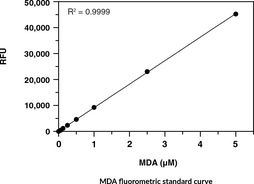
- Assay range: 0.0625-50 µM
- Plate-based colorimetric measurement (530-540 nm) or fluorometric measurement (ex 530 nm, em 550 nm)
Technical Support & Resources
Visit our FAQ
Contact Us
Toll Free Phone (USA and Canada Only): (888) 526-5351
Direct Phone: (734) 975-3888
Product Categories
Application


Technical Information
- Thiobarbituric Acid Reactive Substances
Shipping & Storage Information
Recommended Products



Certificates of Analysis & Batch Specific Data
Provide batch numbers separated by commas to download or request available product inserts, QC sheets, certificates of analysis, data packs, and GC-MS data.
Bioanalysis & Assay Development Services
Your Vision. Our Expertise.
- Bioanalysis and compound screening using Cayman or qualified commercial assay kits
- Development and qualification of fit-for-purpose assays in a variety of formats and platforms
- Experienced scientists dedicated to developing the best strategy for your project
Product Description
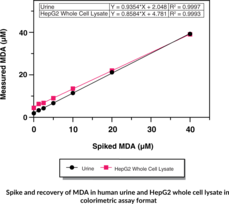
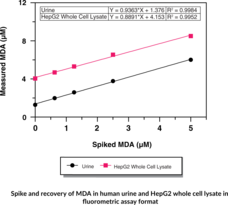
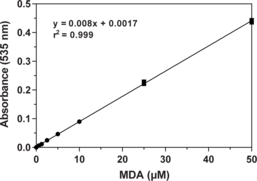
Cayman’s TBARS Assay Kit provides a simple, reproducible, and standardized tool for assaying lipid peroxidation in plasma, serum, urine, tissue homogenates, and whole cell lysates. The MDA-TBA adduct formed by the reaction of MDA and TBA under high temperature (90-100°C) and acidic conditions is measured colorimetrically at 530-540 nm or fluorometrically at an excitation wavelength of 530 nm and an emission wavelength of 550 nm. Although this reaction has a much higher sensitivity when measured fluorometrically, protocols for both methods are provided. When read fluorometrically, this assay has a range of 0.0625-5 µM of MDA equivalents and when read colorimetrically, the assay range is 0.625-50 µM of MDA equivalents.
Needed but not supplied: Please download the kit booklet to verify if UltraPure Water (Milli-Q or equivalent) or any other components are needed for this assay.
WARNING This product is not for human or veterinary use.
References & Product Citations
N-
Inhibition of hepatic oxalate overproduction ameliorates metabolic dysfunction-
The mitochondrial protein TIMM44 is required for angiogenesis in vitro and in vivo. Cell Death Dis. 14(5), 307 (2023).
Adipose lipolysis is important for ethanol to induce fatty liver in the national institute on alcohol abuse and alcoholism murine model of chronic and binge ethanol feeding. Heptaology 77(5), 1688-1701 (2023).
Modeling and optimization of malondialdehyde (MDA) absorbance behavior through response surface methodology (RSM) and artificial intelligence network (AIN): An endeavor to estimate lipid peroxidation by determination of MDA. J. Chemom. e3468, (2022).
Autocrine effects of brain endothelial cell-
A role for glia maturation factor dependent activation of mast cells and microglia in MPTP induced dopamine loss and behavioural deficits in mice. Brain Behav. Immun. 87, 429-443 (2020).
Altered glucocorticoid metabolism represents a feature of macroph-
Neutralization of oxidized phospholipids ameliorates non-
CD8+ T cells regulate tumour ferroptosis during cancer immunotherapy. Nature 569(7755), 270-274 (2019).
Pharmacologic ATF6 activation confers global protection in widespread disease models by reprograming cellular proteostasis. Nat. Commun. 10(1), 187 (2019).
6,7,4'-
Manganese superoxide dismutase deficiency exacerbates the mitochondrial ROS production and oxidative damage in Chagas disease. PLoS Negl. Trop. Dis. 12(7), e0006687 (2018).
PARP1 depletion improves mitochondrial and heart function in Chagas disease: Effects on POLG dependent mtDNA maintenance. PLoS Pathog. 14(5), e1007065 (2018).
Oleoylethanolamide treatment reduces neurobehavioral deficits and brain pathology in a mouse model of Gulf War illness. Sci. Rep. 8(12921), (2018).
Repressed exercise-
Mitochondrial oxidative stress activates COX-
MnTBAP therapy attenuates the downregulation of sodium transporters in obstructive kidney disease. Oncotarget 9(1), 394-403 (2018).
Chronic intermittent hypoxia-
Twenty-
Idebenone and coenzyme Q10 are novel PPARα/γ ligands, with potential for treatment of fatty liver diseases. Dis. Model Mech. 11(9), (2018).
Loss of DDHD2, whose mutation causes spastic paraplegia, promotes reactive oxygen species generation and apoptosis. Cell Death Dis. 9, (2018).
Loss of ULK1 increases RPS6KB1-
Iron-
PARK14 PLA2G6 mutants are defective in preventing rotenone-
Effects of methylsulfonylmethane (MSM) on exercise-
Antioxidant activity of Yichun Blue Honeysuckle (YBHS) berry counteracts CCl4-
Repeated supramaximal exercise-
Analysis of glutathione levels in the brain tissue samples from HIV-
Pinoresinol diglucoside alleviates oxLDL-
Growth hormone control of hepatic lipid metabolism. Diabetes 65(12), 3598-3609 (2016).
Glutamine metabolism is essential for coronavirus replication in host cells and in mice. The Journal of Biological Chemisty 301(1), 108063 (2025).
Erythrocyte antioxidant defenses against cigarette smoking in ischemic heart disease. J. Clin. Diagn. Res. 9(6), BC08-BC11 (2015).
Curcuma purpurascens BI. rhizome accelerates rat excisional wound healing: involvement of Hsp70/Bax proteins, antioxidant defense, and angiogenesis activity. Drug Des. Devel. Ther. 9, 5805-5813 (2015).
Nitrooleic acid attenuates lipid metabolic disorders and liver steatosis in DOCA-
Does oral coenzyme Q10 plus NADH supplementation improve fatigue and biochemical parameters in chronic fatigue syndrome? Antioxid. Redox Signal. 22(8), 679-685 (2015).
Investigating the causes for decreased levels of glutathione in individuals with type II diabetes. PLoS One 10(3), e0118436 (2015).
Liposomal glutathione supplementation restores TH1 cytokine response to Mycobacterium tuberculosis infection in HIV-
Association between maternal micronutrient status, oxidative stress,and common genetic variants in antioxidant enzymes at 15 weeks'gestation in nulliparous women who subsequentlydevelop preeclampsia. Free Rad. Biol. Med. 78, 147-155 (2015).
Oxidant-
Rotenone remarkably attenuates oxidative stress, inflammation, and fibrosis in chronic obstructive uropathy. Mediators Inflamm. 2014, 670106 (2014).
Dietary zinc deficiency exaggerates ethanol-
Glutathione supplementation improves macrophage functions in HIV. J. Interferon. Cytokine Res. 33(5), 270-279 (2013).
An elucidation of neutrophil functions against Mycobacterium tuberculosis infection. Clin. Dev. Immunol. 2013 (959650), 1-11 (2013).
Unveiling the mechanisms for decreased glutathione in individuals with HIV infection. Clin. Dev. Immunol. 2012(734125), 1-10 (2012).
Effects of endogenous PPAR agonist nitro-
Nitro-
Contact Info
Cayman Chemical1180 East Ellsworth RoadAnn Arbor, Michigan 48108 USAToll Free: (800) 364-9897(USA and Canada only)Fax: (734) 971-3640


