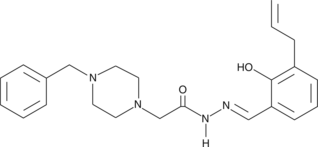
An in vitro procaspase-3 activator
Technical Support & Resources

Visit our FAQ

Contact Us

Toll Free Phone (USA and Canada Only): (888) 526-5351
Direct Phone: (734) 975-3888

Request Technical Support

Technical Support Request

To streamline the process attach the appropriate questionnaire to your inquiry.

Download IHC QuestionnaireDownload WB Questionnaire

View Our Privacy Statement for details on how we use and protect your data. In addition, this site is protected by hCaptcha and its Privacy Policy and Terms of Service apply.

PAC-1

Item No. 10009317

Technical Information
Formal Name
4-(phenylmethyl)-1-piperazineacetic acid, 2-[[2-hydroxy-3-(2-propen-1-yl)phenyl]methylene]hydrazide
CAS Number
315183-21-2
Synonyms
  • Procaspase-activating Compound 1
Molecular Formula
C23H28N4O2
Formula Weight
Purity
≥98%
Formulation
A crystalline solid
DMF: 20 mg/mlDMSO: 20 mg/mlDMSO:PBS (pH 7.2) (1:3): 0.25 mg/mlEthanol: 5 mg/ml
λmax
283, 293, 328 nm
SMILES
C=CCc1cccc(/C=N\NC(=O)CN2CCN(CC2)Cc2ccccc2)c1O
InChi Code
InChI=1S/C23H28N4O2/c1-2-7-20-10-6-11-21(23(20)29)16-24-25-22(28)18-27-14-12-26(13-15-27)17-19-8-4-3-5-9-19/h2-6,8-11,16,29H,1,7,12-15,17-18H2,(H,25,28)/b24-16+
InChi Key
YQNRVGJCPCNMKT-LFVJCYFKSA-N
Shipping & Storage Information
Storage
-20°C
Shipping
Room temperature in continental US; may vary elsewhere
Recommended Products

Certificates of Analysis & Batch Specific Data

Provide batch numbers separated by commas to download or request available product inserts, QC sheets, certificates of analysis, data packs, and GC-MS data.

    Add

    Add

    Add

    Add

    Cayman Chemical
    Visit Our Cancer Resource Center
    Find Tools & Resources to Study the Hallmarks of Cancer
    • Cancer cell signaling & regulation
    • Cancer metabolism
    • Tumor microenvironment
    EXPLORE NOW
    Product Description

    Procaspase-activating compound 1 (PAC-1) is a procaspase-3 activator and a potential drug treatment in cancer cell lines with elevated levels of procaspase-3.1 PAC-1's effectiveness was found to be directly proportional to the procaspase-3 concentration present in cells. In cancer cells, PAC-1 had an IC50 value of 3 nM for induction of cell death, whereas in cells from adjacent normal tissue IC50 values of 3.2-8.5 µM were observed.1

    WARNING This product is not for human or veterinary use.

    References & Product Citations
    Product Description References

    1. Putt, K.S., Chen, G.W., Pearson, J.M., et alSmall-molecule activation of procaspase-3 to caspase-3 as a personalized anticancer strategy. Nat. Chem. Biol. 2(10), 543-550 (2006).