
Technical Support & Resources
Visit our FAQ
Contact Us
Toll Free Phone (USA and Canada Only): (888) 526-5351
Direct Phone: (734) 975-3888
Product Categories
Product Type
Application
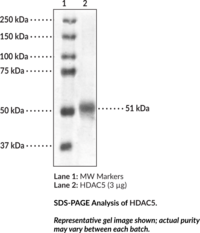
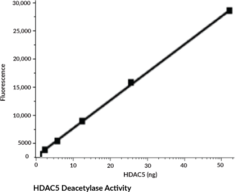
Technical Information
- Histone Deacetylase 5
Shipping & Storage Information
Recommended Products
Certificates of Analysis & Batch Specific Data
Provide batch numbers separated by commas to download or request available product inserts, QC sheets, certificates of analysis, data packs, and GC-MS data.
Product Description
Histone deacetylase 5 (HDAC) is a zinc-dependent metalloenzyme and class IIa HDAC.1 It is composed of an N-terminal regulatory domain, which contains a myocyte-specific enhancer factor 2 (MEF2) binding site, two 14-3-3 binding sites, and a nuclear localization signal, a catalytic domain, and a C-terminal domain that contains a nuclear export signal. HDAC5 shuttles between the cytoplasm and nucleus in a manner dependent on calcium/calmodulin-dependent protein kinase (CaMK) and 14-3-3 and is mainly expressed in the heart, but is also found in brain, breast, colon, and prostate tissues.2,3,4 It acts as a transcriptional corepressor and has many binding partners, including the transcriptional coactivator myocardin, which is involved in smooth muscle differentiation.1 Knockout of Hdac5 induces cardiac hypertrophy in mice and impairs spatial memory formation in a mouse model of Alzheimer’s disease.5,6 Tumor levels of HDAC5 are increased in various cancer types.7 Cayman’s HDAC5 (human, recombinant) protein can be used for enzyme activity assays.
WARNING This product is not for human or veterinary use.
References & Product Citations
1. Class II histone deacetylases: From sequence to function, regulation, and clinical implication. Mol. Cell. Biol. 25(8), 2873-2884 (2005).
2. Identification of a signal-
3. Regulation of histone deacetylase 4 and 5 and transcriptional activity by 14-
4. Histone deacetylases (HDACs): Characterization of the classical HDAC family. Biochem J. 370(Pt 3), 737-749 (2003).
5. Histone deacetylases 5 and 9 govern responsiveness of the heart to a subset of stress signals and play redundant roles in heart development. Mol. Cell. Biol. 24(19), 8467-8476 (2004).
6. Loss of HDAC5 impairs memory function: Implications for Alzheimer’s disease. J. Alzheimers Dis. 33(1), 35-44 (2013).
7. Insights into the function and clinical application of HDAC5 in cancer management. Front. Oncol. 11:661620, (2021).
Contact Info
Cayman Chemical1180 East Ellsworth RoadAnn Arbor, Michigan 48108 USAToll Free: (800) 364-9897(USA and Canada only)Fax: (734) 971-3640


