Active, pure human recombinant enzyme
Technical Support & Resources

Visit our FAQ

Contact Us

Toll Free Phone (USA and Canada Only): (888) 526-5351
Direct Phone: (734) 975-3888

Request Technical Support

Technical Support Request

To streamline the process attach the appropriate questionnaire to your inquiry.

Download IHC QuestionnaireDownload WB Questionnaire

View Our Privacy Statement for details on how we use and protect your data. In addition, this site is protected by hCaptcha and its Privacy Policy and Terms of Service apply.

HDAC9 (human, recombinant)

Item No. 10009466

Technical Information
Synonyms
  • Histone Deacetylase 9
Purity
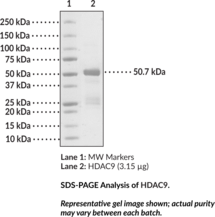
≥75% estimated by SDS-PAGE
Source
10 µg of recombinant C-terminal His-tagged protein expressed in baculovirus expression system
Amino Acids
604-1066
MW
50.7 kDa
40 mM Tris-HCl, pH 8.0, with 110 mM sodium chloride, 2.2 mM potassium chloride, 20% glycerol, and 200 mM imidazole
Shipping & Storage Information
Storage
-80°C
Shipping
Dry ice in continental US; may vary elsewhere
Recommended Products

Certificates of Analysis & Batch Specific Data

Provide batch numbers separated by commas to download or request available product inserts, QC sheets, certificates of analysis, data packs, and GC-MS data.

    Add

    Product Description

    HDAC9 is a Class IIa HDAC which is homologous to the yeast HDAC1 and is larger in size than the other classes of HDACs.1,2 Class IIa HDACs contain a highly conserved C-terminal deacetylase catalytic domain (~420 amino acids) and N-terminal domain with no similarity to HDACs in other classes. Class II HDACs can shuttle between the nucleus and cytoplasm, suggesting possible extranuclear functions including regulating the acetylation status of non-histone substrates. By modifying chromatin structure and other non-histone proteins, HDACs play an important role in controlling complex biological events, including cell development, differentiation, programmed cell death, angiogenesis, and inflammation.1,2 Considering these major roles, it is conceivable that dysregulation of HDACs and subsequent imbalance of acetylation and deacetylation may be involved in the pathogenesis of various diseases, including cancer and inflammatory diseases.2

    WARNING This product is not for human or veterinary use.

    References & Product Citations
    Product Description References

    1. Lin, H.Y., Chen, C.S., Lin, S.P., et alTargeting histone deacetylase in cancer therapy. Med. Res. Rev. 26(4), 397-413 (2006).

    2. Huang, L. Targeting histone deacetylases for the treatment of cancer and inflammatory diseases. J. Cell. Physiol. 209(3), 611-616 (2006).