
Technical Support & Resources
Visit our FAQ
Contact Us
Toll Free Phone (USA and Canada Only): (888) 526-5351
Direct Phone: (734) 975-3888
Product Categories
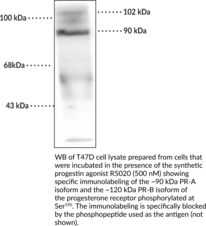
Progesterone Receptor (Phospho-Ser190) Monoclonal Antibody (Clone 1154)
Item No. 10009762
Technical Information
Shipping & Storage Information
Recommended Products
Certificates of Analysis & Batch Specific Data
Provide batch numbers separated by commas to download or request available product inserts, QC sheets, certificates of analysis, data packs, and GC-MS data.

Visit Our Cancer Resource Center
Find Tools & Resources to Study the Hallmarks of Cancer
- Cancer cell signaling & regulation
- Cancer metabolism
- Tumor microenvironment
Product Description
There is accumulating evidence to suggest that progesterone plays an essential role in the regulation of growth and differentiation of mammary glands and thus may play a key role in breast cancer.1 The biological response to progesterone is mediated by two distinct forms of the human progesterone receptor (PR-A and PR-B forms). In most cell contexts, the B form functions as a transcriptional activator, whereas the A form functions as a transcriptional inhibitor of steroid hormones.2,3 Recently it has been demonstrated that there is differential hormone dependent regulation of the phosphorylation of the A and B forms of the receptor.4 Treatment of T47D breast cancer cells with progestin agonist increases the phosphorylation of Ser190 and Ser294 with different kinetics. These phosphorylation events may differentially affect the transcriptional activity of the receptor.
WARNING This product is not for human or veterinary use.
References & Product Citations
1. Regulation of signal transduction pathways by estrogen and progesterone. Annu. Rev. Physiol. 67, 335-376 (2005).
2. Progesterone receptor isoform A but not B is expressed in endometriosis. J. Clin. Endocrinol. Metab. 85(8), 2897-2902 (2000).
3. Distinct molecular pathways mediate progesterone-
4. Differential hormone-
Contact Info
Cayman Chemical1180 East Ellsworth RoadAnn Arbor, Michigan 48108 USAToll Free: (800) 364-9897(USA and Canada only)Fax: (734) 971-3640


