
Technical Support & Resources
Information provided in the product description is from published literature. Due to the nature of scientific experimentation, your results (e.g., selectivity and effective concentrations) or specific application for this product may differ. If you have questions about how this product fits your application, please contact our technical support staff.
Visit our FAQ
Contact Us
Toll Free Phone (USA and Canada Only): (888) 526-5351
Direct Phone: (734) 975-3888
Technical Information
- NSC 174939
- STA 4783
Shipping & Storage Information
Recommended Products
Certificates of Analysis & Batch Specific Data
Provide batch numbers separated by commas to download or request available product inserts, QC sheets, certificates of analysis, data packs, and GC-MS data.

Visit Our Cancer Resource Center
Find Tools & Resources to Study the Hallmarks of Cancer
- Cancer cell signaling & regulation
- Cancer metabolism
- Tumor microenvironment
Product Description
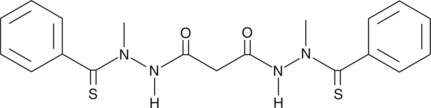
Elesclomol is an inducer of apoptosis and a copper ionophore.1 It induces the production of reactive oxygen species (ROS) and increases oxidative stress response gene expression in Ramos (RA 1) B cell lymphoma cells when used at a concentration of 500 nM. Elesclomol (100 nM) disrupts the mitochondrial membrane potential and induces apoptosis in Ramos (RA 1) cells. It induces ferroptosis by selectively transporting copper into the inner mitochondrial membrane in MDA-MB-435 breast cancer cells.2 Elesclomol preloaded with copper (3.6 mg/kg) increases brain mitochondrial copper and mitochondrial complex IV, also known as cytochrome c oxidase, levels, as well as increases survival time, body weight, and brain weight and prevents changes in neuronal morphology in a mottled-brindled mouse model of Menkes disease, a fatal, X-linked condition characterized by copper-transporting ATPase (ATP7A) gene mutation, which produces altered catecholamine and copper levels, hypopigmentation, and severe neurodegeneration.3
WARNING This product is not for human or veterinary use.
References & Product Citations
1. Elesclomol induces cancer cell apoptosis through oxidative stress. Mol. Cancer Ther. 7(8), 2319-2327 (2008).
2. The oncology drug elesclomol selectively transports copper to the mitochondria to induce oxidative stress in cancer cells. Free Radic. Biol. Med. 52(10), 2142-2150 (2012).
3. Elesclomol alleviates Menkes pathology and mortality by escorting Cu to cuproenzymes in mice. Science 368(6491), 620-625 (2020).
Contact Info
Cayman Chemical1180 East Ellsworth RoadAnn Arbor, Michigan 48108 USAToll Free: (800) 364-9897(USA and Canada only)Fax: (734) 971-3640


