
Technical Support & Resources
Visit our FAQ
Contact Us
Toll Free Phone (USA and Canada Only): (888) 526-5351
Direct Phone: (734) 975-3888
Product Categories
Product Type
Application
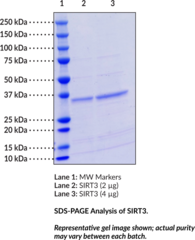
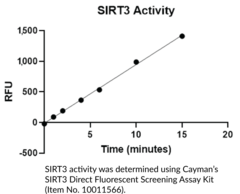

Technical Information
- Mitochondrial Nicotinamide Adenine Dinuclear-
dependent Deacetylase - NAD-
dependent Deacetylase 3 - Silent Information Regulator 3
- SIR2L3
- SIR2-
like Protein 3 - Sirtuin 3
Shipping & Storage Information
Recommended Products
Certificates of Analysis & Batch Specific Data
Provide batch numbers separated by commas to download or request available product inserts, QC sheets, certificates of analysis, data packs, and GC-MS data.
Product Description
The sirtuins (SIRTs) represent a distinct class of trichostatin A-insensitive lysyl-deacetylases (class III HDACs) and have been shown to catalyze a reaction that couples lysine deacetylation to the formation of nicotinamide and O-acetyl-ADP-ribose from NAD+ and the abstracted acetyl group.1,2,3 There are seven human SIRTs, which have been designated SIRT 1-7.4 SIRT3, is a mitochondrial protein, with its N-terminal 25 amino acid residues responsible for its localization.5,6 Synthesized as an enzymatically inactive protein, human SIRT3 is activated by a matrix-processing peptidase.6 Recently, it was demonstrated that SIRT3 is translocated to the mitochondria from the nucleus during cellular stress or by the overexpression of SIRT3 itself.7 In mice, caloric restriction up-regulates SIRT3 expression levels in white and brown adipose tissue (WAT & BAT). Cold exposure also induces SIRT3 in brown adipose tissue (BAT).8 The constitutive expression of SIRT3 promotes the expression of PGC-1a, UCP1, and other genes involved in mitochondrial functions, indicating that SIRT3 modulates adaptive thermogenesis in BAT.8
WARNING This product is not for human or veterinary use.
References & Product Citations
1. Transcriptional silencing and longevity protein Sir2 is an NAD-
2. Silent information regulator 2 family of NAD-
3. Coupling of histone deacetylation to NAD breakdown by the yeast silencing protein Sir2: Evidence for acetyl transfer from substrate to an NAD breakdown product. Proc. Natl. Acad. Sci. USA 98(2), 415-420 (2001).
4. Phylogenetic classification of prokaryotic and eukaryotic Sir2-
5. SIRT3, a human SIR2 homologue, is an NAD-
6. The human silent information regulator (Sir)2 homologue hSIRT3 is a mitochondrial nicotinamide adenine dinucleotide-
7. SirT3 is a nuclear NAD+-
8. SIRT3, a mitochondrial sirtuin deacetylase, regulates mitochondrial function and thermogenesis in brown adipocytes. The Journal of Biological Chemisty 280(14), 13560-13567 (2005).
Contact Info
Cayman Chemical1180 East Ellsworth RoadAnn Arbor, Michigan 48108 USAToll Free: (800) 364-9897(USA and Canada only)Fax: (734) 971-3640


