
A bacterial quorum-sensing signaling molecule
Technical Support & Resources

Information provided in the product description is from published literature. Due to the nature of scientific experimentation, your results (e.g., selectivity and effective concentrations) or specific application for this product may differ. If you have questions about how this product fits your application, please contact our technical support staff.

Visit our FAQ

Contact Us

Toll Free Phone (USA and Canada Only): (888) 526-5351
Direct Phone: (734) 975-3888

Request Technical Support

Technical Support Request

To streamline the process attach the appropriate questionnaire to your inquiry.

Download IHC QuestionnaireDownload WB Questionnaire

View Our Privacy Statement for details on how we use and protect your data. In addition, this site is protected by hCaptcha and its Privacy Policy and Terms of Service apply.

N-3-oxo-hexadec-11(Z)-enoyl-L-Homoserine lactone

Item No. 10011238
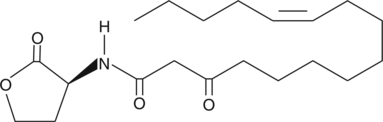
Technical Information
Formal Name
3-oxo-N-[(3S)-tetrahydro-2-oxo-3-furanyl]-(11Z)-hexadecenamide
CAS Number
1269663-80-0
Synonyms
  • 3-oxo-C16:1-Δ11cis-(L)-HSL
Molecular Formula
C20H33NO4
Formula Weight
Purity
≥98%
A 10 mg/ml solution in acetonitrile
DMF: 30 mg/mlDMSO: 30 mg/ml
λmax
246 nm
SMILES
O=C1[C@@H](NC(CC(CCCCCCC/C=C\CCCC)=O)=O)CCO1
InChi Code
InChI=1S/C20H33NO4/c1-2-3-4-5-6-7-8-9-10-11-12-13-17(22)16-19(23)21-18-14-15-25-20(18)24/h5-6,18H,2-4,7-16H2,1H3,(H,21,23)/b6-5-/t18-/m0/s1
InChi Key
UKVJHGAETBFGBY-XFHJGTJQSA-N
Shipping & Storage Information
Storage
-20°C
Shipping
Room temperature in continental US; may vary elsewhere
Recommended Products

Certificates of Analysis & Batch Specific Data

Provide batch numbers separated by commas to download or request available product inserts, QC sheets, certificates of analysis, data packs, and GC-MS data.

    Add

    Add

    Add

    Add

    Cayman Chemical
    Neutrophil Biology Wall Poster

    Explore how neutrophils shape the immune response in health and disease. This poster highlights neutrophil pathogen defense mechanisms, including phagocytosis, degranulation, and NETosis, as well as neutrophil roles in inflammation and NET-associated pathologies.

    DOWNLOAD NOW
    Product Description

    Quorum sensing is a regulatory system used by bacteria for controlling gene expression in response to increasing cell density.1 This regulatory process manifests itself with a variety of phenotypes including biofilm formation and virulence factor production.2 Coordinated gene expression is achieved by the production, release, and detection of small diffusible signal molecules called autoinducers. The N-acylated homoserine lactones (AHLs) comprise one such class of autoinducers, each of which generally consists of a fatty acid coupled with homoserine lactone (HSL). Regulation of bacterial quorum sensing signaling systems to inhibit pathogenesis represents a new approach to antimicrobial therapy in the treatment of infectious diseases.3 AHLs vary in acyl group length (C4-C18), in the substitution of C3 (hydrogen, hydroxyl, or oxo group), and in the presence or absence of one or more carbon-carbon double bonds in the fatty acid chain. These differences confer signal specificity through the affinity of transcriptional regulators of the LuxR family.4 An unspecified positional and geometric isomer of 3-oxo-C16:1-(L)-HSL is produced by the F2/5 strain of A. vitis, the bacterium responsible for grape crown gall and its resulting loss of agricultural productivity.5

    WARNING This product is not for human or veterinary use.

    References & Product Citations
    Product Description References

    1. González, J.E., and Keshavan, N.D. Messing with bacterial quorum sensing. Microbiol. Mol. Biol. Rev. 70(4), 859-875 (2006).

    2. Gould, T.A., Herman, J., Krank, J., et alSpecificity of acyl-homoserine lactone syntheses examined by mass spectrometry. J. Bacteriol. 188(2), 773-783 (2006).

    3. Cegelski, L., Marshall, G.R., Eldridge, G.R., et alThe biology and future prospects of antivirulence therapies. Nat. Rev. Microbiol. 6(1), 17-27 (2008).

    4. Penalver, C.G.N., Morin, D., Cantet, F., et alMethylobacterium extorquens AM1 produces a novel type of acyl-homoserine lactone with a double unsaturated side chain under methylotrophic growth conditions. FEBS Lett. 580(2), 561-567 (2006).

    5. Hao, G., and Burr, T.J. Regulation of long-chain N-acyl-homoserine lactones in agrobacterium vitis. J. Bacteriol. 188(6), 2173-2183 (2006).

