Active, pure human recombinant enzyme
Technical Support & Resources

Visit our FAQ

Contact Us

Toll Free Phone (USA and Canada Only): (888) 526-5351
Direct Phone: (734) 975-3888

Request Technical Support

Technical Support Request

To streamline the process attach the appropriate questionnaire to your inquiry.

Download IHC QuestionnaireDownload WB Questionnaire

View Our Privacy Statement for details on how we use and protect your data. In addition, this site is protected by hCaptcha and its Privacy Policy and Terms of Service apply.

15-Lipoxygenase-2 (human, recombinant)

Item No. 10011263

Technical Information
Synonyms
  • 15-LOX-2
  • 15-LO-2
Purity
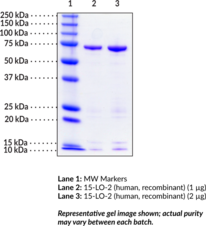
≥85% estimated by SDS-PAGE
Source
Active human recombinant N-terminal T7-His-tagged protein expressed in E. coli
MW
78 kDa
PBS, pH 7.5, with 1 mM DTT, 20% glycerol
UniProt Accession №
O15296
Shipping & Storage Information
Storage
-80°C
Shipping
Dry ice in continental US; may vary elsewhere
Recommended Products

Certificates of Analysis & Batch Specific Data

Provide batch numbers separated by commas to download or request available product inserts, QC sheets, certificates of analysis, data packs, and GC-MS data.

    Add

    Lipid Resource Center
    Discover Products & Resources for Lipid Research
    • High-purity lipid standards
    • Lipid roles in biology
    • Lipids in health & disease
    • Lipids for pharmaceutical development
    • Protocols, advice, & resources
    EXPLORE NOW
    Product Description

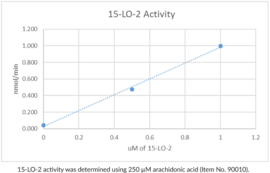
    Two types of 15-lipoxygenase (15-LO) have been discovered and characterized, both of which metabolize arachidonic acid (AA) to produce 15(S)-hydroxyeicosatetraenoic acid (15(S)-HETE). 15-LO-1 oxygenates AA at both C-15 and C-12, whereas 15-LO-2 exclusively oxygenates C-15 of AA.1,2 Human 15-LO-2 has a molecular mass of approximately 76 kDa and exhibits approximately 40% identity to the reticulocyte 15-LO-1.2,3 Expression of 15-LO-2 appears to be restricted to prostate, lung, skin, and cornea and may play a role in the normal development of these tissues.4 The protein levels and enzymatic activity of 15-LO-2 are both down-regulated in prostate cancer compared with normal and benign prostate tissues, implicating a possible protective role for 15-LO-2 against tumor formation.4,5,6 Cayman's 15-LO-2 (human, recombinant) is expressed and purified from E. coli. The purity was determined using gel electrophoresis followed by coomassie staining. 15-LO-2 specific activity was established using arachidonic acid as the substrate and monitoring diene formation by measuring absorbance 236 nm.

    WARNING This product is not for human or veterinary use.

    References & Product Citations
    Product Description References

    1. Kuhn, H., Barnett, J., Grunberger, D., et alOverexpression, purification and characterization of human recombinant 15-lipoxygenase. Biochim. Biophys. Acta 1169(1), 80-89 (1993).

    2. Brash, A.R., Chang, M.S., and Boeglin, W.E. Discovery of a second 15S-lipoxygenase in humans. Proc. Natl. Acad. Sci. USA 94(12), 6148-6152 (1997).

    3. Kilty, I., Logan, A., and Vickers, P.J. Differential characteristics of human 15-lipoxygenase isozymes and novel splice variant of 15S-lipoxygenase. Eur. J. Biochem. 266(1), 83-93 (1999).

    4. Tang, S., Bhatia, B., Maldonado, C.J., et alEvidence that arachidonate 15-lipoxygenase 2 is a negative cell cycle regulator in normal prostate epithelial cells. The Journal of Biological Chemisty 277(18), 16189-16201 (2002).

    5. Shappell, S.B., Boeglin, W.E., Olson, S.J., et al15-lipoxygenase-2 (15-LOX-2) is expressed in benign prostatic epithelium and reduced in prostate adenocarcinoma. Am. J. Pathol. 155(1), 235-245 (1999).

    6. Jack, G.S., Brash, A.R., Olson, S.J., et alReduced 15-lipoxygenase-2 immunostaining in prostate adenocarcinoma: Correlation with grade and expression in high-grade prostatic intraepithelial neoplasia. Hum. Pathol. 31(9), 1146-1154 (2000).

    Product Citations

    Anthonymuthu, T.S., Kenny, E.M., Shrivastava, I., et alEmpowerment of 15-lipoxygenase catalytic competence in selective oxidation of membrane ETE-PE to ferroptotic death signals, HpETE-PE. J. Am. Chem. Soc. 140(51), 17835-17839 (2018).

    Kagan, V.E., Mao, G., Qu, F., et alOxidized arachidonic and adrenic PEs navigate cells to ferroptosis. Nat. Chem. Biol. 13(1), 81-90 (2017).