
Technical Support & Resources
Visit our FAQ
Contact Us
Toll Free Phone (USA and Canada Only): (888) 526-5351
Direct Phone: (734) 975-3888
Technical Information
- Group 10 secretory phospholipase A2
- GXPLA2
- Phosphatidylcholine 2-Acylhydrolase 10
- PLA2G10
- Secretory Phospholipase A2 (human Group X)
- sPLA2-X
Shipping & Storage Information
Recommended Products
Certificates of Analysis & Batch Specific Data
Provide batch numbers separated by commas to download or request available product inserts, QC sheets, certificates of analysis, data packs, and GC-MS data.
Lipid Resource Center
Discover Products & Resources for Lipid Research
- High-purity lipid standards
- Lipid roles in biology
- Lipids in health & disease
- Lipids for pharmaceutical development
- Protocols, advice, & resources
Product Description
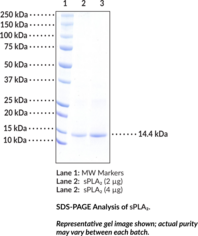
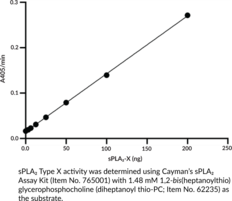
Secretory phospholipase A2 (sPLA2) (Type X) is a calcium-dependent PLA2 superfamily member that is encoded by PLA2G10 in humans.1 It is composed of an N-terminal signal peptide, a highly-conserved calcium-binding loop, a catalytic domain, sPLA2 Type I- and II-specific disulfides that provide stability, and a C-terminal extension. sPLA2 (Type X) is expressed in spleen, thymus, peripheral blood leukocytes, pancreas, lung, and colon, as well as neutrophils and keratinocytes.2,3,4 Upon activation, sPLA2 (Type X) is released into the extracellular space where it acts in a paracrine or autocrine manner and preferentially catalyzes the hydrolysis of phosphatidylethanolamine (PE) and phosphatidylcholine (PC) over phosphatidylserine (PS) at the sn-2 position, liberating the free fatty acid and lysophospholipid, which serve as substrates for the synthesis of bioactive lipid metabolites.2,1 sPLA2 (Type X) increases arachidonic acid (Item Nos. 90010 | 90010.1 | 10006607) release from HEK293 cells and prostaglandin E2 (Item No. 14010) levels in HEK293 cells expressing human COX-2 but not COX-1.5 Pla2g10-/- mice have decreased inflammatory cell infiltration and airway edema in a model of ovalbumin-induced allergic asthma.6 Airway lining fluid levels of sPLA2 (Type X) are increased in patients with asthma.7 Cayman’s sPLA2 (human, recombinant Type X) protein can be used for enzyme activity assays. The specific activity of Cayman's sPLA2 (human, recombinant Type X) was established using Cayman’s sPLA2 Assay Kit (Item No. 765001) with 1.48 mM 1,2-bis(heptanoylthio) glycerophosphocholine (Item No. 62235) as the substrate.
WARNING This product is not for human or veterinary use.
References & Product Citations
1. Secreted phospholipase A2 revisited. J. Biochem. 150(3), 233-255 (2011).
2. Cloning, chromosomal mapping, and expression of a novel human secretory phospholipase A2. The Journal of Biological Chemisty 272(25), 15745-15752 (1997).
3. Groups IV, V, and X phospholipases A2s in human neutrophils. Role in eicosanoid production and Gram-
4. Characterization of group X phospholipase A2 as the major enzyme secreted by human keratinocytes and its regulation by the phorbol ester TPA. J. Invest. Dermatol. 116(1), 31-39 (2001).
5. Exogenously added human group X secreted phospholipase A2 but not the group I B, I I A, and V enzymes effeciently release arachidonic acid from adherent mammalian cells. The Journal of Biological Chemisty 275, 3179-3191 (2000).
6. Importance of group X-
7. Regulation and function of epithelial secreted phospholipase A2 group X in asthma. Am. J. Respir. Crit. Care Med. 188(1), 42-50 (2013).
Contact Info
Cayman Chemical1180 East Ellsworth RoadAnn Arbor, Michigan 48108 USAToll Free: (800) 364-9897(USA and Canada only)Fax: (734) 971-3640


