
Technical Support & Resources
Visit our FAQ
Contact Us
Toll Free Phone (USA and Canada Only): (888) 526-5351
Direct Phone: (734) 975-3888
Product Categories
Research Area
Sphingosine Kinase 1 Polyclonal FITC Antibody
Item No. 10012201
Technical Information
- SK1
- SPHK1
- SPK1
Shipping & Storage Information
Recommended Products
Certificates of Analysis & Batch Specific Data
Provide batch numbers separated by commas to download or request available product inserts, QC sheets, certificates of analysis, data packs, and GC-MS data.
Product Description
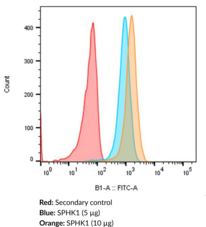
The primary use of this antibody conjugate is for the detection of SPHK1 in intact cells by direct immunolabeling methods such as flow cytometry or immunofluorescence microscopy. SPHK1 is one of the enzymes involved in sphingolipid metabolism. SPHK1 catalyzes the phosphorylation of sphingosine to sphingosine-
WARNING This product is not for human or veterinary use.
References & Product Citations
1. Sphingosine kinase 1 is an intracellular effector of phosphatidic acid. The Journal of Biological Chemisty 279(43), 44763-44774 (2004).
2. Sphingolipid metabolism: Roles in signal transduction and disruption by fumonisins. Environ. Health Perspect. 109(suppl. 2), 283-289 (2001).
3. Synthesis and evaluation of sphingoid analogs as inhibitors of sphingosine kinase. Bioorg. Med. Chem. 13, 3475-3485 (2005).
4. SphK1 and SphK2, sphingosine kinase isoenzymes with opposing functions in sphingolipid metabolism. The Journal of Biological Chemisty 280(44), 37118-37129 (2005).
5. Human sphingosine kinase: Purification, molecular cloning and characterization of the native and recombinant enzymes. Biochem. J. 350(Pt 2), 429-441 (2000).
Contact Info
Cayman Chemical1180 East Ellsworth RoadAnn Arbor, Michigan 48108 USAToll Free: (800) 364-9897(USA and Canada only)Fax: (734) 971-3640


