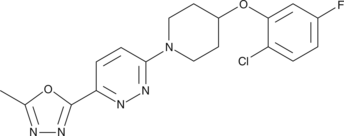
A potent, selective inhibitor of stearoyl-CoA desaturase
Technical Support & Resources

Visit our FAQ

Contact Us

Toll Free Phone (USA and Canada Only): (888) 526-5351
Direct Phone: (734) 975-3888

Request Technical Support

Technical Support Request

To streamline the process attach the appropriate questionnaire to your inquiry.

Download IHC QuestionnaireDownload WB Questionnaire

View Our Privacy Statement for details on how we use and protect your data. In addition, this site is protected by hCaptcha and its Privacy Policy and Terms of Service apply.

CAY10566

Item No. 10012562

Technical Information
Formal Name
3-[4-(2-chloro-5-fluorophenoxy)-1-piperidinyl]-6-(5-methyl-1,3,4-oxadiazol-2-yl)-pyridazine
CAS Number
944808-88-2
Molecular Formula
C18H17ClFN5O2
Formula Weight
Purity
≥98%
Formulation
A crystalline solid
DMF: 20 mg/mlDMF:PBS (pH 7.2) (1:5): 0.15 mg/mlDMSO: 10 mg/mlEthanol: 0.15 mg/ml
SMILES
Cc1nnc(o1)c1ccc(nn1)N1CCC(CC1)Oc1cc(F)ccc1Cl
InChi Code
InChI=1S/C18H17ClFN5O2/c1-11-21-24-18(26-11)15-4-5-17(23-22-15)25-8-6-13(7-9-25)27-16-10-12(20)2-3-14(16)19/h2-5,10,13H,6-9H2,1H3
InChi Key
WFOFPVXMPTVOTJ-UHFFFAOYSA-N
Shipping & Storage Information
Storage
-20°C
Shipping
Room temperature in continental US; may vary elsewhere
Recommended Products

Certificates of Analysis & Batch Specific Data

Provide batch numbers separated by commas to download or request available product inserts, QC sheets, certificates of analysis, data packs, and GC-MS data.

    Add

    Add

    Add

    Add

    Product Description

    Stearoyl-CoA desaturase (SCD) catalyzes the committed step of the conversion of saturated, long-chain fatty acids to monounsaturated fatty acids. The SCD1 gene is thought to play a key role in lipid homeostasis and body weight regulation.1,2,3 Thus, modulating SCD1 activity pharmacologically may be a useful tool for regulating type 2 diabetes, dyslipidemia, and obesity. CAY10566 is a potent and selective inhibitor of SCD1 that demonstrates IC50 values of 4.5 and 26 nM in mouse and human enzymatic assays, respectively.4 This compound inhibits the conversion of saturated, long-chain fatty acyl-CoAs to monounsaturated, long-chain fatty acyl-CoAs in HepG2 cells with IC50 values of 7.9 and 6.8 nM, respectively, when heptadecanoic acid and palmitic acid are used as the substrate.4

    WARNING This product is not for human or veterinary use.

    References & Product Citations
    Product Description References

    1. Cohen, P., Miyazaki, M., Socci, N.D., et alRole for stearoyl-CoA desaturase-1 in leptin-mediated weight loss. Science 297, 240-243 (2002).

    2. Dobrzyn, P., Sampath, H., Dobrzyn, A., et alLoss of stearoyl-CoA desaturase 1 inhibits fatty acid oxidation and increases glucose utilization in the heart. Am. J. Physiol. Endocrinol. Metab. 294, E357-E364 (2008).

    3. Miyazaki, M., Flowers, M.T., Sampath, H., et alHepatic stearoyl-CoA desaturase-1 deficiency protects mice from carbohydrate-induced adiposity and hepatic steatosis. Cell Metab. 6, 484-496 (2007).

    4. Liu, G., Lynch, J.K., Freeman, J., et alDiscovery of potent, selective, orally bioavailable stearoyl-CoA desaturase 1 inhibitors. J. Med. Chem. 50(13), 3086-3100 (2007).

    Product Citations

    Vincent, B.M., Tardiff, D.F., Piotrowski, J.S., et alInhibiting stearoyl-CoA desaturase ameliorates α-synuclein cytotoxicity. Cell Rep. 25(10), 2742-2754 (2018).

    Yi, J., Zhu, J., Wu, J., et alOncogenic activation of PI3K-AKT-mTOR signaling suppresses ferroptosis via SREBP-mediated lipogenesis. Proc. Natl. Acad. Sci. USA 202017152 (2020).

    Magtanong, L., Ko, P.-J., To, M., et alExogenous monounsaturated fatty acids promote a ferroptosis-resistant cell state. Cell Chem. Biol. 26(3), 420-432 (2019).