
Technical Support & Resources
Visit our FAQ
Contact Us
Toll Free Phone (USA and Canada Only): (888) 526-5351
Direct Phone: (734) 975-3888
Technical Information
- PGD2 Receptor
- Prostaglandin D2 Receptor
Shipping & Storage Information
Recommended Products
Certificates of Analysis & Batch Specific Data
Provide batch numbers separated by commas to download or request available product inserts, QC sheets, certificates of analysis, data packs, and GC-MS data.
Lipid Resource Center
Discover Products & Resources for Lipid Research
- High-purity lipid standards
- Lipid roles in biology
- Lipids in health & disease
- Lipids for pharmaceutical development
- Protocols, advice, & resources
Product Description
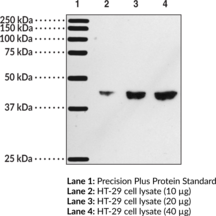
Prostaglandin D2 (PGD2) binds to two receptor subtypes: DP1 and CRTH2/DP2, which are both membrane-bound G protein-coupled receptors (GPCRs) but do not have significant homology and are differentially expressed.1 The DP1 receptor is expressed in various tissues and cells including the brain, spleen, lungs, bone marrow, stomach, skin, and mast cells.2,3,4 It is coupled to Gαs, and its activation increases intracellular cAMP levels.5 Signaling through the DP1 receptor is involved in inflammation, allergy, and sleep regulation.5,1 Cayman’s DP1 Receptor Polyclonal Antibody can be used for immunofluorescence (IF) and Western blot (WB) applications. The antibody recognizes the DP1 receptor at approximately 41 kDa from human, mouse, and rat samples.
WARNING This product is not for human or veterinary use.
References & Product Citations
1. Role of the L-
2. Molecular characterization of a mouse prostaglandin D receptor and functional expression of the cloned gene. Proc. Natl. Acad. Sci. USA 91, 11192-11196 (1994).
3. Molecular cloning and characterization of the human prostanoid DP receptor. The Journal of Biological Chemisty 270(32), 18910-18916 (1995).
4. Prostanoid receptors: Structures, properties, and functions. Physiol. Rev. 79(4), 1193-1226 (1999).
5. The DP receptor, allergic inflammation and asthma. Prostaglandins Leukot. Essent. Fatty Acids 69(2-3), 187-194 (2003).
Comprehensive expression analysis of prostanoid enzymes and receptors in the human endometrium across the menstrual cycle. mol. Hum. Reprod. 17(3), 182-192 (2011).
Contact Info
Cayman Chemical1180 East Ellsworth RoadAnn Arbor, Michigan 48108 USAToll Free: (800) 364-9897(USA and Canada only)Fax: (734) 971-3640


