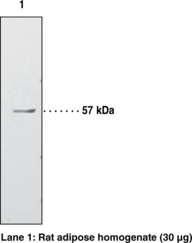
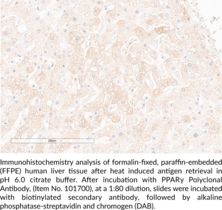
For immunochemical detection of PPARγ
Technical Support & Resources

Visit our FAQ

Contact Us

Toll Free Phone (USA and Canada Only): (888) 526-5351
Direct Phone: (734) 975-3888

Request Technical Support

Technical Support Request

To streamline the process attach the appropriate questionnaire to your inquiry.

Download IHC QuestionnaireDownload WB Questionnaire

View Our Privacy Statement for details on how we use and protect your data. In addition, this site is protected by hCaptcha and its Privacy Policy and Terms of Service apply.

PPARγ Polyclonal Antibody

Item No. 101700

Technical Information
Synonyms
  • Peroxisome Proliferator-activated Receptor γ
Immunogen
Synthetic peptide from the internal region of PPARγ1
500 µl of Peptide affinity-purified polyclonal antibody
Storage Buffer
PBS, pH 7.2, with 50% glycerol and 0.02% sodium azide
Host
Rabbit
Applications
IHC, IP, and WB
Cross Reactivity
(+) PPARγ1(+) ​PPARγ2
Species Reactivity
(+) Human(+) Mouse(+) Rat; other species not tested
UniProt Accession №
P37231
Origin
Animal/Rabbit
Shipping & Storage Information
Storage
-20°C
Shipping
Wet ice in continental US; may vary elsewhere
Recommended Products

Certificates of Analysis & Batch Specific Data

Provide batch numbers separated by commas to download or request available product inserts, QC sheets, certificates of analysis, data packs, and GC-MS data.

    Add

    Product Description

    PPARγ is a ligand-activated transcription factor involved in the regulation of lipid homeostasis and may function as a master regulator of adipogenesis.1,2,3,4 PPARγ mRNA is expressed prominently in adipose tissue, but is also found in large intestine, kidney, liver, and small intestine.5 Alternative splicing of the PPARγ gene results in at least two mRNA species that differ at their 5' ends.1,6 Human PPARγ1 and PPARγ2 proteins are 53 and 57 kDa, respectively, based on the deduced amino acid sequences.6 PPARγ2 is the major PPARγ isoform found in both the cytosolic and nuclear fractions of undifferentiated 3T3-L1 cells.7 Total cellular PPARγ2 protein increases approximately 2-fold following differentiation of 3T3-L1 cells, whereas only small quantities of PPARγ1 are detected in the nuclear fraction following differentiation.7

    WARNING This product is not for human or veterinary use.

    References & Product Citations
    Product Description References

    1. Greene, M.E., Blumberg, B., McBride, O.W., et alIsolation of the human peroxisome proliferator activated receptor γ cDNA: Expression in hematopoietic cells and chromosomal mapping. Gene Expr. 4, 281-299 (1995).

    2. Elbrecht, A., Chen, Y., Cullinan, C.A., et alMolecular cloning, expression and characterization of human peroxisome proliferator activated receptors γ 1 and γ 2. Biochem. Biophys. Res. Commun. 224, 431-437 (1996).

    3. Spiegelman, B.M., and Flier, J.S. Adipogenesis and obesity: Rounding out the big picture. Cell 87, 377-389 (1995).

    4. Lemberger, T., Desvergne, B., and Wahli, W. Peroxisome proliferator-activated receptors: A nuclear receptor signaling pathway in lipid physiology. Annu. Rev. Cell Dev. Biol. 12, 335-363 (1996).

    5. Fajas, L., Auboeu, D., Raspé, E., et alThe organization, promoter analysis, and expression of the human PPARγ gene. The Journal of Biological Chemisty 272, 18779-18789 (1997).

    6. Mukherjee, R., Jow, L., Croston, G.E., et alIdentification, characterization, and tissue distribution of human peroxisome proliferator-activated receptor (PPAR) isoforms PPARγ2 versus PPARγ1 and activation with retinoid X receptor agonists and antagonists. The Journal of Biological Chemisty 272, 8071-8076 (1997).

    7. Thuillier, P., Baillie, R., Sha, X., et alCytosolic and nuclear distribution of PPARγ2 in differentiating 3T3-L1 preadipocytes. J. Lipid Res. 39, 2329-2338 (1998).

    Product Citations

    Wu, M.-R., Hou, M.-H., Lin, Y.-L., et al2,4,5-TMBA, a natural inhibitor of cyclooxygenase-2, suppresses adipogenesis and promotes lipolysis in 3T3-L1 adipocytes. J. Agric. Food Chem. 60(29), 7262-7269 (2012).

    Magee, T.R., Han, G., Cherian, B., et alDown-regulation of transcription factor peroxisome proliferator-activated receptor in programmed hepatic lipid dysregulation and inflammation in intrauterine growth-restricted offspring. Am. J. Obstet. Gynecol. 199:e1-271.e5, (2008).