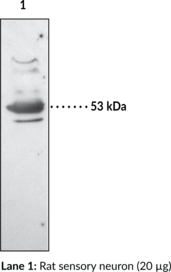
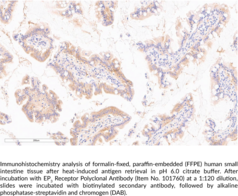
For immunochemical detection of the EP3 receptor
Related Products
Technical Support & Resources

Visit our FAQ

Contact Us

Toll Free Phone (USA and Canada Only): (888) 526-5351
Direct Phone: (734) 975-3888

Request Technical Support

Technical Support Request

To streamline the process attach the appropriate questionnaire to your inquiry.

Download IHC QuestionnaireDownload WB Questionnaire

View Our Privacy Statement for details on how we use and protect your data. In addition, this site is protected by hCaptcha and its Privacy Policy and Terms of Service apply.

EP3 Receptor Polyclonal Antibody

Item No. 101760

Technical Information
Synonyms
  • PGE2 Receptor 3
  • Prostaglandin E2 Receptor 3
Immunogen
Synthetic peptide from an internal region of human EP3 receptor
500 µl of peptide affinity-purified polyclonal antibody
Storage Buffer
PBS, pH 7.2, with 0.02% sodium azide and 50% glycerol
Host
Rabbit
Applications
ICC, IHC, and WB
Cross Reactivity
(+) EP3 receptor(-) EP1 receptor(-) EP2 receptor(-) EP4 receptor
Species Reactivity
(+) Human(+) Bovine(+) Mouse(+) Rat
UniProt Accession №
P43115
Origin
Animal/Rabbit
Shipping & Storage Information
Storage
-20°C
Shipping
Wet ice in continental US; may vary elsewhere
Recommended Products

Certificates of Analysis & Batch Specific Data

Provide batch numbers separated by commas to download or request available product inserts, QC sheets, certificates of analysis, data packs, and GC-MS data.

    Add

    Lipid Resource Center
    Discover Products & Resources for Lipid Research
    • High-purity lipid standards
    • Lipid roles in biology
    • Lipids in health & disease
    • Lipids for pharmaceutical development
    • Protocols, advice, & resources
    EXPLORE NOW
    Product Description

    The biological effects of prostaglandin E2 (PGE2) are mediated through interaction with four distinct membrane-bound G-protein coupled EP receptors: EP1, EP2, EP3, and EP4.1,2 As a result of splice variation, the EP3 receptor can be expressed as multiple isoforms that differ in the length and sequence of their C-terminal tails.2,3 The signal transduction mechanism varies depending on the isoform being expressed, implicating the importance of the C-terminal region of the receptor for coupling to G-proteins.2,3 The EP3 receptor is expressed in a variety of tissues with highest levels in kidney, pancreas, and uterus.3,4,5

    WARNING This product is not for human or veterinary use.

    References & Product Citations
    Product Description References

    1. Coleman, R.A., Eglen, R.M., Jones, R.L., et alClassification of prostanoid receptors IUPHAR receptor compendium. IUPHAR Compendium 1-12 (1997).

    2. Narumiya, S., Sugimoto, Y., and Ushikubi, F. Prostanoid receptors: Structures, properties, and functions. Physiol. Rev. 79(4), 1193-1226 (1999).

    3. Kotani, M., Tanaka, I., Ogawa, Y., et alMolecular cloning and expression of multiple isoforms of human prostaglandin E receptor EP3 subtype generated by alternative messenger RNA splicing: Multiple second messenger systems and tissue-specific distributions. Mol. Pharmacol. 48, 869-879 (1995).

    4. Sugimoto, Y., Namba, T., Honda, A., et alCloning and expression of a cDNA for mouse prostaglandin E receptor EP3 subtype. The Journal of Biological Chemisty 267, 6463-6466 (1992).

    5. Yang, J., Xia, M., Goetzl, E.J., et alCloning and expression of the EP3-subtype of human receptors for prostaglandin E2. Biochem. Biophys. Res. Commun. 198, 999-1006 (1994).

    Product Citations

    Minhas, P.S., Latif-Hernandez, A., McReynolds, M.R., et alRestoring metabolism of myeloid cells reverses cognitive decline in ageing. Nature (2021).

    Nirmal, J., Tyagi, P., Chuang, Y.-C., et alFunctional and molecular characterization of hyposensitive underactive bladder tissue and urine in streptozotocin-induced diabetic rat. PloS One 9(7), e102644 (2014).

    Roca-Ferrer, J., Garcia-Garcia, F.J., Pereda, J., et alReduced expression of COXs and production of prostaglandin E2 in patients with nasal polyps with or without aspirin-intolerant asthma. J. Allergy Clin. Immunol. 128, 66-72 (2011).

    George, R.J., Sturmoski, M.A., Anant, S., et alEP4 mediates PGE2 dependent cell survival through the PI3 kinase/AKT pathway. Prostaglandins Other Lipid Mediat. 83(1-2), 112-120 (2007).