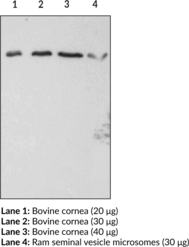
For immunochemical detection of the FP receptor
Technical Support & Resources

Visit our FAQ

Contact Us

Toll Free Phone (USA and Canada Only): (888) 526-5351
Direct Phone: (734) 975-3888

Request Technical Support

Technical Support Request

To streamline the process attach the appropriate questionnaire to your inquiry.

Download IHC QuestionnaireDownload WB Questionnaire

View Our Privacy Statement for details on how we use and protect your data. In addition, this site is protected by hCaptcha and its Privacy Policy and Terms of Service apply.

FP Receptor Polyclonal Antibody

Item No. 101802

Technical Information
Synonyms
  • PGF Receptor
  • Prostaglandin F Receptor
Immunogen
Synthetic peptide from the N-terminal cytoplasmic region of mouse protein FP receptor
Peptide-affinity purified antibody lyophilized from 500 µl
Storage Buffer
TBS, pH 7.4, with 0.5% BSA when reconstituted in 500 μl deionized water
Host
Rabbit
Isotype
IgG
Applications
WB
Species Reactivity
(+) Human(+) Bovine(+) Mouse(+) Ovine(+) Rat
UniProt Accession №
P43117
Origin
Animal/Rabbit
Shipping & Storage Information
Storage
-20°C
Shipping
Wet ice in continental US; may vary elsewhere
Recommended Products

Certificates of Analysis & Batch Specific Data

Provide batch numbers separated by commas to download or request available product inserts, QC sheets, certificates of analysis, data packs, and GC-MS data.

    Add

    Lipid Resource Center
    Discover Products & Resources for Lipid Research
    • High-purity lipid standards
    • Lipid roles in biology
    • Lipids in health & disease
    • Lipids for pharmaceutical development
    • Protocols, advice, & resources
    EXPLORE NOW
    Product Description

    The prostaglandin F receptor (FP receptor) is a G protein-coupled receptor known to elicit smooth muscle contraction in a variety of tissues.1 FP receptor mRNA is found in reproductive, gastric, neural, and ocular tissues as well as specialized cells of the kidney.2,3,4,5 Two FP receptor isoforms, FPA and FPB have been identified in sheep.6 FPB receptor is truncated at the carboxy-terminus thereby preventing desensitization (which normally occurs by protein kinase C phosphorylation of FPA) and produces aberrant signalling in FPB transfectants.7,8 The existence of a truncated human FP isoform responsible for signal-amplification contributing to luteolysis, cell growth, or malignant transformation is currently unknown.6,7,8,9 Cayman’s FP Receptor Polyclonal Antibody can be used for Western blot applications. The calculated size of FP Receptor is 41 kDa and this antibody recognizes multiple bands from 50-67 kDa from human, bovine, mouse, ovine, and rat samples.

    WARNING This product is not for human or veterinary use.

    References & Product Citations
    Product Description References

    1. Narumiya, S., Sugimoto, Y., and Ushikubi, F. Prostanoid receptors: Structures, properties, and functions. Physiol. Rev. 79(4), 1193-1226 (1999).

    2. Abramovitz, M., Boie, Y., Nguyen, T., et alCloning and expression of a cDNA for the human prostanoid FP receptor. The Journal of Biological Chemisty 269(4), 2632-2636 (1994).

    3. Lake, S., Gullberg, H., Wahlqvist, J., et alCloning of the rat and human prostaglandin F receptors and the expression of the rat prostaglandin F receptor. FEBS Lett. 355(3), 317-325 (1994).

    4. Kitanaka, J., Hasimoto, H., Sugimoto, Y., et alCloning and expression of a cDNA for rat prostaglandin F receptor. Prostaglandins 48, 31-41 (1994).

    5. Mukhopadhyay, P., Bian, L., Yin, H., et alLocalization of EP1 and FP receptors in human ocular tissues by in situ hybridization. Invest. Ophthalmol. Vis. Sci. 42(2), 424-428 (2001).

    6. Pierce, K.L., Bailey, T.J., Hoyer, P.B., et alCloning of a carboxyl-terminal isoform of the prostanoid FP receptor. The Journal of Biological Chemisty 272(2), 883-887 (1997).

    7. Fujino, H., Srinivasan, D., Pierce, K.L., et alDifferential regulation of prostaglandin F receptor isoforms by protein kinase C. Mol. Pharmacol. 57, 353-358 (2000).

    8. Fujino, H., and Regan, J.W. FP prostanoid receptor activation of a T-cell factor/β-catenin signaling pathway. The Journal of Biological Chemisty 276(16), 12489-12492 (2001).

    9. Sugimoto, Y., Yamasaki, A., Segi, E., et alFailure of parturition in mice lacking the prostaglandin F receptor. Science 277, 681-683 (1997).