
Technical Support & Resources
Visit our FAQ
Contact Us
Toll Free Phone (USA and Canada Only): (888) 526-5351
Direct Phone: (734) 975-3888
Product Categories
Product Type
Technical Information
Shipping & Storage Information
Recommended Products
Certificates of Analysis & Batch Specific Data
Provide batch numbers separated by commas to download or request available product inserts, QC sheets, certificates of analysis, data packs, and GC-MS data.
Product Description
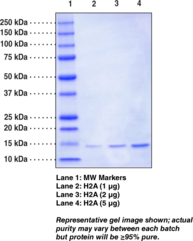
Histone H2A is a core histone that forms a dimer with histone H2B.1 Two histone H2A/H2B dimers form an octameric nucleosome with a histone H3/H4 tetramer, around which DNA wraps, allowing it to be condensed. Histone H2A can be post-translationally modified via methylation of the arginine at position 3 by protein arginine methyltransferase 1 (PRMT1), PRMT5, or PRMT6, which is associated with both transcriptional activation and repression.2 When methylated by PRMT7, it is associated with DNA damage repair. The arginine residue at position 3 of histone H2A is also subject to citrullination by protein arginine deiminase 4 (PAD4). Histone H2A is ubiquitinated by ubiquitin-specific protease 12 (USP12) during the gastrula stage of Xenopus development.3 The post-translational modifications on histone H2A vary between each stage of Xenopus development and are enriched on nucleosomes in Xenopus embryos that contain both active and repressive histone modifications.4 Cayman’s Histone H2A (Xenopus, recombinant) protein can be used as a substrate for enzyme activity assays, as well as for Western blot (WB) applications.
WARNING This product is not for human or veterinary use.
References & Product Citations
1. The histone core complex: An octamer assembled by two sets of protein-
2. Protein arginine methylation and citrullination in epigenetic regulation. ACS Chem. Biol. 11(3), 654-668 (2016).
3. Regulation of histone H2A and H2B deubiquitination and Xenopus development by USP12 and USP46. The Journal of Biological Chemisty 286(9), 7190-7201 (2011).
4. Phosphorylation and arginine methylation mark histone H2A prior to deposition during Xenopus laevis development. Epigenetics Chromatin 7, 22 (2014).
Contact Info
Cayman Chemical1180 East Ellsworth RoadAnn Arbor, Michigan 48108 USAToll Free: (800) 364-9897(USA and Canada only)Fax: (734) 971-3640


