Active, pure human recombinant enzyme
Technical Support & Resources

Visit our FAQ

Contact Us

Toll Free Phone (USA and Canada Only): (888) 526-5351
Direct Phone: (734) 975-3888

Request Technical Support

Technical Support Request

To streamline the process attach the appropriate questionnaire to your inquiry.

Download IHC QuestionnaireDownload WB Questionnaire

View Our Privacy Statement for details on how we use and protect your data. In addition, this site is protected by hCaptcha and its Privacy Policy and Terms of Service apply.

PAF Acetylhydrolase (human, recombinant)

Item No. 10279

Technical Information
Synonyms
  • Group-VIIA phospholipase A2
  • LDL-PLA(2)
  • Lipoprotein PLA2
  • PAF-AH
  • PLA2G7
  • gVIIA-PLA2
  • Lp-PLA2
  • Platelet-activating Factor Acetylhydrolase
Purity
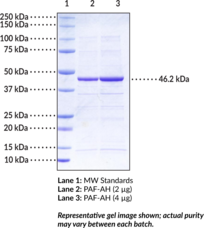
≥75% estimated by SDS-PAGE
Source
Active recombinant N-terminal hexahistidine-tagged protein expressed in E. coli
Amino Acids
42-441 (full-length)
MW
46.4 kDa
50 mM sodium phosphate, pH 7.2, 100 mM NaCl, 10% glycerol
UniProt Accession №
Q13093
Shipping & Storage Information
Storage
-80°C
Shipping
Dry ice in continental US; may vary elsewhere
Recommended Products

Certificates of Analysis & Batch Specific Data

Provide batch numbers separated by commas to download or request available product inserts, QC sheets, certificates of analysis, data packs, and GC-MS data.

    Add

    Lipid Resource Center
    Discover Products & Resources for Lipid Research
    • High-purity lipid standards
    • Lipid roles in biology
    • Lipids in health & disease
    • Lipids for pharmaceutical development
    • Protocols, advice, & resources
    EXPLORE NOW
    Product Description

    Platelet-activating factor (PAF) is an important lipid mediator involved in inflammation. PAF-acetylhydrolase (PAF-AH) is an extracellular phospholipase A2 which hydrolyzes the acetyl group at the sn-2 position of phospholipids.1 Two main types of PAF-AH have been characterized, namely the secreted (i.e. plasma) and intracellular enzymes, which are encoded on individual genes and share only 41% homology at the amino acid level.2,3 Cayman’s PAF-AH is the secreted calcium-independent isoform. PAF deacetylation by PAF-AH causes loss of biological activity, making PAF-AH potentially useful as an anti-inflammation therapy.

    WARNING This product is not for human or veterinary use.

    References & Product Citations
    Product Description References

    1. Tjoelker, L.W., Wilder, C., Eberhardt, C., et alAnti-inflammatory properties of a platelet-activating factor acetylhydrolase. Nature 374(6522), 549-553 (1995).

    2. Stafforini, D.M., McIntyre, T.M., Zimmerman, G.A., et alPlatelet-activating factor acetylhydrolases. The Journal of Biological Chemisty 272(29), 17895-17898 (1997).

    3. Hattori, K., Adachi, H., Matsuzawa, A., et alcDNA cloning and expression of intracellular platelet-activating factor (PAF) acetylhydrolase II. Its homology with plasma PAF acetylhydrolase. The Journal of Biological Chemisty 271(51), 33032-33038 (1996).