
For immunochemical detection of NAPE-PLD
Related Products
Technical Support & Resources

Visit our FAQ

Contact Us

Toll Free Phone (USA and Canada Only): (888) 526-5351
Direct Phone: (734) 975-3888

Request Technical Support

Technical Support Request

To streamline the process attach the appropriate questionnaire to your inquiry.

Download IHC QuestionnaireDownload WB Questionnaire

View Our Privacy Statement for details on how we use and protect your data. In addition, this site is protected by hCaptcha and its Privacy Policy and Terms of Service apply.

NAPE-PLD (Internal) Polyclonal Antibody

Item No. 10305
Technical Information
Synonyms
  • N-Acyl-Phosphatidylethanolamine-Hydrolysing Phospholipase D
Immunogen
Synthetic peptide from an internal region of human protein NAPE-PLD
500 µl of peptide affinity-purified polyclonal antibody
Storage Buffer
PBS, pH 7.2, with 50% glycerol and 0.02% sodium azide
Host
Rabbit
Applications
WB
Species Reactivity
(+) Human(+) Mouse(+) Rat
UniProt Accession №
Q6IQ20
Origin
Animal/Rabbit
Shipping & Storage Information
Storage
-20°C
Shipping
Wet ice in continental US; may vary elsewhere
Recommended Products

Certificates of Analysis & Batch Specific Data

Provide batch numbers separated by commas to download or request available product inserts, QC sheets, certificates of analysis, data packs, and GC-MS data.

    Add

    Product Description

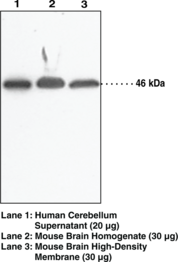
    N-acylethanolamines (NAEs) are involved in diverse biological processes such as inflammatory regulation, apoptosis, and tissue degeneration.1 In animals, NAEs are mainly biosynthesized via a membrane phospholipid-dependent pathway, which is the enzymatic hydrolysis of N-acyl-phosphatidylethanolamine (NAPE). The enzyme catalyzing this reaction is a phospholipase D subtype selective for NAPE named N-acyl-phosphatidylethanolamine-hydrolysing phospholipase D (NAPE-PLD). It has been cloned from mouse, rat, and human and is 393-396 amino acids in length, with an estimated molecular weight of 46 kDa. Both NAPE-PLD mRNA and protein activity have been detected in a wide range of tissues with the highest levels in brain, kidney, and testis.2 In rat, NAPE-PLD activity in the brain is low in neonates and is 15-fold higher in adults, whereas the activity remains constant in the heart during development.3

    WARNING This product is not for human or veterinary use.

    References & Product Citations
    Product Description References

    1. Hansen, H.S., Moesgaard, B., Petersen, G., et alPutative neuroprotective actions of N-acyl-ethanolamines. Pharmacol. Ther. 95(2), 119-126 (2002).

    2. Okamoto, Y., Morishita, J., Tsuboi, K., et alMolecular characterization of a phospholipase D generating anandamide and its congeners. The Journal of Biological Chemisty 279(7), 5298-5305 (2004).

    3. Moesgaard, B., Petersen, G., Jaroszewski, J.W., et alAge dependent accumulation of N-acyl-ethanolamine phospholipids in ischemic rat brain: A 31P NMR and enzyme activity study. J. Lipid Res. 41(6), 985-990 (2000).

    Product Citations

    Kucera, R., Bouskila, J., Elkrief, L., et alExpression and localization of CB1R, NAPE-PLD, and FAAH in the vervet monkey nucleus accumbens. Sci. Rep. 8, 8689 (2018).

    Maccarone, R., Rapino, C., Zerti, D., et alModulation of type-1 and type-2 cannabinoid receptors by saffron in a rat model of retinal neurodegeneration. PLoS One 11(11), e0166827 (2016).

