Pure human recombinant protein
Technical Support & Resources

Visit our FAQ

Contact Us

Toll Free Phone (USA and Canada Only): (888) 526-5351
Direct Phone: (734) 975-3888

Request Technical Support

Technical Support Request

To streamline the process attach the appropriate questionnaire to your inquiry.

Download IHC QuestionnaireDownload WB Questionnaire

View Our Privacy Statement for details on how we use and protect your data. In addition, this site is protected by hCaptcha and its Privacy Policy and Terms of Service apply.

SIRT7 (human, recombinant)

Item No. 10316

Technical Information
Synonyms
  • NAD-dependent deacetylase 7
  • Silent Information Regulator 7
  • Sirtuin 7
  • SIR2L7
  • SIR2-like protein 7
Purity
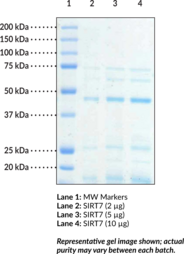
≥35% estimated by SDS-PAGE
Source
Recombinant human N-terminal hexahistidine-tagged enzyme expressed in E. coli
Amino Acids
2-400 (full length)
MW
49.3 kDa
50 mM NaPO4, pH 7.2, with 100 mM NaCl and 20% glycerol
UniProt Accession №
Q9NRC8
Shipping & Storage Information
Storage
-80°C
Shipping
Dry ice in continental US; may vary elsewhere
Recommended Products

Certificates of Analysis & Batch Specific Data

Provide batch numbers separated by commas to download or request available product inserts, QC sheets, certificates of analysis, data packs, and GC-MS data.

    Add

    Product Description

    The sirtuins represent a distinct class of trichostatin A-insensitive lysyl-deacetylases (class III HDACs) and have been shown to catalyze a reaction that couples lysine deacetylation to the formation of nicotinamide and O-acetyl-ADP-ribose from NAD+ and the abstracted acetyl group.1,2,3 There are seven human sirtuins, which have been designated SIRT1-SIRT7.4 SIRT7 has been shown to activate transcription by RNA polymerase I and deacetylate p53.5 SIRT7 prevents progressive functional deterioration of the heart, and is suggested to play an important role in regulation of stress responses and cell death in the heart.6

    WARNING This product is not for human or veterinary use.

    References & Product Citations
    Product Description References

    1. Imai, S.I., Armstrong, C.M., Kaeberlein, M., et alTranscriptional silencing and longevity protein Sir2 is an NAD-dependent histone deacetylase. Nature 403(6771), 795-800 (2000).

    2. Tanner, K.G., Landry, J., Sternglanz, R., et alSilent information regulator 2 family of NAD-dependent histone/protein deacetylases generates a unique product, 1-O-acetyl-ADP-ribose. Proc. Natl. Acad. Sci. USA 97(26), 14178-14182 (2000).

    3. Tanny, J.C., and Moazed, D. Coupling of histone deacetylation to NAD breakdown by the yeast silencing protein Sir2: Evidence for acetyl transfer from substrate to an NAD breakdown product. Proc. Natl. Acad. Sci. USA 98(2), 415-420 (2001).

    4. Frye, R.A. Phylogenetic classification of prokaryotic and eukaryotic Sir2-like proteins. Biochem. Biophys. Res. Commun. 273(2), 793-798 (2000).

    5. Lavu, S., Boss, O., Elliot, P.J., et alSirtuins-novel therapeutic targets to treat age-associated diseases. Nat. Rev. Drug Discov. 7, 841-853 (2008).

    6. Vakhrusheva, O., Smolka, C., Gajawada, P., et alSirt7 increases stress resistance of cardiomyocytes and prevents apoptosis and inflammatory cardiomyopathy in mice. Circ. Res. 102, 703-710 (2008).