
Technical Support & Resources
Visit our FAQ
Contact Us
Toll Free Phone (USA and Canada Only): (888) 526-5351
Direct Phone: (734) 975-3888
Product Categories
Product Type
Application
Technical Information
- Mitochondrial Regulatory Protein SIR2 Homolog 5
- NAD-
dependent Deacetylase 5 - NAD-dependent Protein Deacylase Sirtuin-5
- Silent Information Regulator 5
- SIR2L5
- SIR2-
like Protein 5 - Sirtuin 5
Shipping & Storage Information
Recommended Products
Certificates of Analysis & Batch Specific Data
Provide batch numbers separated by commas to download or request available product inserts, QC sheets, certificates of analysis, data packs, and GC-MS data.
Lipid Resource Center
Discover Products & Resources for Lipid Research
- High-purity lipid standards
- Lipid roles in biology
- Lipids in health & disease
- Lipids for pharmaceutical development
- Protocols, advice, & resources
Product Description
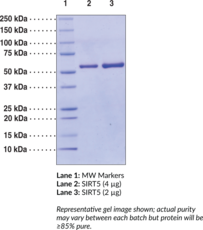
Sirtuin 5 (SIRT5) is an enzyme that catalyzes the NAD-dependent removal of malonyl, succinyl, and glutaryl groups from target proteins.1,2 Although it was originally characterized as a class III histone deacetylase (HDAC), SIRT5 exhibits weak NAD-dependent deacetylase activity in vitro and in vivo. SIRT5 is localized to mitochondria and is composed of a zinc binding domain and a Rossmann fold domain with the NAD and substrate binding sites located at the domain interface.1 Knockdown of Sirt5 induces hepatic and muscle protein hypersuccinylation, as well as fatty acid oxidation defects and hypertrophic cardiomyopathy in mice.3 SIRT5 protein and mRNA expression is elevated in human non-small cell lung cancer (NSCLC) tumors and is predictive of tumor recurrence and poor survival.4 SIRT5 also interacts with severe acute respiratory syndrome coronavirus 2 (SARS-CoV-2) non-structural protein 14 (Nsp14), an exoribonuclease component of the viral replicase-transcriptase complex.5 Cayman’s SIRT5 (human, recombinant) protein can be used for ELISA and western blot applications.
WARNING This product is not for human or veterinary use.
References & Product Citations
1. Sirtuin 5: A review of structure, known inhibitors and clues for developing new inhibitors. Sci. China Life Sci. 60, 249-256 (2017).
2. A novel continuous assay for the deacylase sirtuin 5 and other deacetylases. J. Med. Chem. 58(18), 7217-7223 (2015).
3. Metabolomics-
4. Emerging roles for SIRT5 in metabolism and cancer. Antioxid. Redox Signal. 28(8), 677-690 (2018).
5. A SARS-
Contact Info
Cayman Chemical1180 East Ellsworth RoadAnn Arbor, Michigan 48108 USAToll Free: (800) 364-9897(USA and Canada only)Fax: (734) 971-3640


