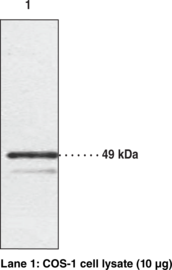
For immunochemical detection of CMKLR1
Related Products
Technical Support & Resources

Visit our FAQ

Contact Us

Toll Free Phone (USA and Canada Only): (888) 526-5351
Direct Phone: (734) 975-3888

Request Technical Support

Technical Support Request

To streamline the process attach the appropriate questionnaire to your inquiry.

Download IHC QuestionnaireDownload WB Questionnaire

View Our Privacy Statement for details on how we use and protect your data. In addition, this site is protected by hCaptcha and its Privacy Policy and Terms of Service apply.

Chemokine-Like Receptor 1 Polyclonal Antibody

Item No. 10325

Technical Information
Synonyms
  • CMKLR1
  • DEZ
  • GPCR ChemR23
  • Resolvin E1 Receptor
Immunogen
Synthetic peptide from the C-terminal region of human CMKLR1
500 μl of peptide affinity-purified polyclonal antibody
Storage Buffer
PBS, pH 7.2, with 50% glycerol and 0.02% sodium azide
Host
Rabbit
Applications
FC, IF, IHC, and WB
Species Reactivity
(+) Human CMKLR1(+) Monkey CMKLR1(+) Mouse CMKLR1(+) Rat CMKLR1
UniProt Accession №
Q99788
Origin
Animal/Rabbit
Shipping & Storage Information
Storage
-20°C
Shipping
Wet ice in continental US; may vary elsewhere
Recommended Products

Certificates of Analysis & Batch Specific Data

Provide batch numbers separated by commas to download or request available product inserts, QC sheets, certificates of analysis, data packs, and GC-MS data.

    Add

    Cayman Chemical
    Neutrophil Biology Wall Poster

    Explore how neutrophils shape the immune response in health and disease. This poster highlights neutrophil pathogen defense mechanisms, including phagocytosis, degranulation, and NETosis, as well as neutrophil roles in inflammation and NET-associated pathologies.

    DOWNLOAD NOW
    Product Description

    Chemokine-Like Receptor 1 (CMKLR1) is a G protein-coupled receptor relevant to the cellular chemotaxis of dendritic cells and macrophages.1 This receptor is also expressed in brain, liver, lung, and kidney tissues.1,2 Chemerin, or TIG2, has been identified as the natural ligand for this receptor.3 Resolvin E1 has also been identified as a ligand for CMKLR1, acting to dampen cellular responses to inflammation.1,4,5 Chemerin is an 18 kDa protein that plays a role in immunity, inflammation, chemotaxis, and has been identified as an adipokine.6,7,2 Human CMKLR1 shares 80% sequence homology with its mouse ortholog.3 The human receptor exists in two isoforms, differing only by two amino acids due to a premature stop codon. Isoform one has 363 amino acids and an expected molecular weight of 42.3 kDa. Cayman’s CMKLR1 polyclonal antibody recognizes the C-terminal region of the protein and cell permeabilization is recommended prior to whole cell staining.

    WARNING This product is not for human or veterinary use.

    References & Product Citations
    Product Description References

    1. Arita, M., Bianchini, F., Aliberti, J., et alSterochemical assignment, antiinflammatory properties, and receptor for the omega-3 lipid mediator resolvin E1. J. Exp. Med. 201(5), 713-722 (2005).

    2. Takahashi, M., Takahashi, Y., Takahashi, K., et alChemerin enhances insulin signaling and potentiates insulin-stimulated glucose uptake in 3T3-L1 adipocytes. FEBS Lett. 582, 573-578 (2008).

    3. Wittamer, V., Grégoire, F., Robberecht, P., et alThe C-terminal nonapeptide of mature chemerin activates the chemerin receptor with low nanomolar potency. The Journal of Biological Chemisty 279(11), 9956-9962 (2004).

    4. Arita, M., Ohira, T., Sun, Y.P., et alResolvin E1 selectively interacts with leukotriene B4 receptor BLT1 and ChemR23 to regulate inflammation. J. Immunol. 178, 3912-3917 (2007).

    5. Cash, J.L., Hart, R., Russ, A., et alSynthetic chemerin-derived peptides suppress inflammation through ChemR23. J. Exp. Med. 205(4), 767-775 (2008).

    6. Roh, S.G., Song, S.H., Choi, K.C., et alChemerin-a new adipokine that modulates adipogenesis via its own receptor. Biochem. Biophys. Res. Commun. 362, 1013-1018 (2007).

    7. Campbell, E.L., Louis, N.A., Tomassetti, S.E., et alResolvin E1 promotes mucosal surface clearance of neutrophils: a new paradigm for inflammatory resolution. The FASEB Journal 21, 3162-3170 (2007).