
Technical Support & Resources
Visit our FAQ
Contact Us
Toll Free Phone (USA and Canada Only): (888) 526-5351
Direct Phone: (734) 975-3888
Product Categories
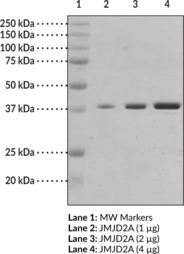
JMJD2A (human, recombinant; His-tagged)
Item No. 10336
Technical Information
- Lysine (K)-specific Demethylase 4A
- JHDM3A
- Jumonji Domain Containing 2A
- KDM4A
Shipping & Storage Information
Recommended Products
Certificates of Analysis & Batch Specific Data
Provide batch numbers separated by commas to download or request available product inserts, QC sheets, certificates of analysis, data packs, and GC-MS data.

Visit Our Cancer Resource Center
Find Tools & Resources to Study the Hallmarks of Cancer
- Cancer cell signaling & regulation
- Cancer metabolism
- Tumor microenvironment
Product Description
Jumonji Domain Containing 2A (JMJD2A) is a lysine-specific demethylase that catalyzes the demethylation of histone H3 at lysine residues 9 and 36 and histone H1.4 at lysine residue 26.1,2,3 It is composed of the JmjN N-terminal domain, JmjC catalytic domain, two plant homeodomains (PHDs), and two tudor domains that recognize the methylated histones.3 JMJD2A is ubiquitously expressed and localized to the nucleus.4 It is involved in the regulation of gene expression in a context-dependent manner, having roles in both transcriptional silencing and activation of androgen and estrogen receptors (ERs).3 Knockdown of JMJD2A inhibits the proliferation of ER-positive and -negative breast cancer cells and induces apoptosis and cell cycle arrest in colon cancer cells. It is overexpressed in various cancers, including prostate, lung, and colorectal, as well as glioblastomas and endometrial carcinomas, and is associated with higher tumor grade and decreased disease-free survival in breast cancer.5 Cayman's JMJD2A (human, recombinant) can be used for ELISA and Western blot (WB) applications.
WARNING This product is not for human or veterinary use.
References & Product Citations
1. Specificity and mechanism of JMJD2A, a trimethyllysine-
2. Distinct binding modes specify the recognition of methylated histones H3K4 and H4K20 by JMJD2A-
3. KDM4/JMJD2 histone demethylases: Epigenetic regulators in cancer cells. Cancer Res. 73(10), 2936-2942 (2013).
4. Functional characterization of JMJD2A, a histone deacetylase-
5. Advances in histone demethylase KDM4 as cancer therapeutic targets. The FASEB Journal 34(3), 3461-3484 (2020).
Contact Info
Cayman Chemical1180 East Ellsworth RoadAnn Arbor, Michigan 48108 USAToll Free: (800) 364-9897(USA and Canada only)Fax: (734) 971-3640


