
Technical Support & Resources
Visit our FAQ
Contact Us
Toll Free Phone (USA and Canada Only): (888) 526-5351
Direct Phone: (734) 975-3888
Product Categories
EP4 Receptor (C-Term) Polyclonal PE Antibody
Item No. 10479
Technical Information
- Prostaglandin E2 Receptor 4
Shipping & Storage Information
Recommended Products
Certificates of Analysis & Batch Specific Data
Provide batch numbers separated by commas to download or request available product inserts, QC sheets, certificates of analysis, data packs, and GC-MS data.
Lipid Resource Center
Discover Products & Resources for Lipid Research
- High-purity lipid standards
- Lipid roles in biology
- Lipids in health & disease
- Lipids for pharmaceutical development
- Protocols, advice, & resources
Product Description
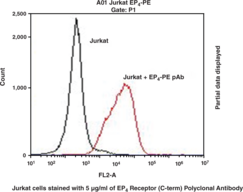
Prostaglandin E2 (PGE2) binds to four receptor subtypes: EP1, EP2, EP3, and EP4, which are all membrane-bound G protein-coupled receptors (GPCRs).1,2,3 The EP4 receptor was originally classified as the EP2 receptor but was not activated by the EP2 agonist butaprost (Item Nos. 13740 | 13741) and was later found to be a distinct receptor with sequence differences.4,5 It is expressed in many tissues, including the intestine, heart, kidney, lungs, and brain, and is also expressed in peripheral blood leukocytes and macrophages.3 The EP4 receptor is coupled to Gαs, and its activation increases intracellular cAMP levels, leading to tissue-specific effects. It induces smooth muscle relaxation, angiogenesis, T cell expansion, osteoblast differentiation, and bone resorption and inhibits TNF-α production in monocytes and macrophages, among other activities. PTGER4, the gene encoding the EP4 receptor, is overexpressed in a variety of cancers, and antagonism of the receptor in animal models inhibits tumor growth and angiogenesis.6 In contrast, EP4 receptor activation has anti-inflammatory and neuroprotective activities in vitro and in animal models.7,8 Cayman’s EP4 Receptor (C-Term) Polyclonal PE Antibody can be used for flow cytometry (FC) and immunofluorescence (IF) applications.
WARNING This product is not for human or veterinary use.
References & Product Citations
1. Prostanoid receptors: Structures, properties, and functions. Physiol. Rev. 79(4), 1193-1226 (1999).
2. Classification of prostanoid receptors IUPHAR receptor compendium. IUPHAR Compendium 1-12 (1997).
3. The prostanoid EP4 receptor and its signaling pathway. Pharmacol. Rev. 65(3), 1010-1052 (2013).
4. Identification of prostaglandin E receptor 'EP2' cloned from mastocytoma cells as EP4 subtype. FEBS Lett. 364(4), 339-341 (1995).
5. Cloning of a novel human prostaglandin receptor with characteristics of the pharmacologically defined EP2 subtype. Mol. Pharmacol. 46(2), 213-220 (1994).
6. Eicosanoids in cancer: Prostaglandin E2 receptor 4 in cancer therapeutics and immunotherapy. Front. Pharmacol. 11, 819 (2020).
7. Anti-
8. Anti-
Contact Info
Cayman Chemical1180 East Ellsworth RoadAnn Arbor, Michigan 48108 USAToll Free: (800) 364-9897(USA and Canada only)Fax: (734) 971-3640


