
Technical Support & Resources
Visit our FAQ
Contact Us
Toll Free Phone (USA and Canada Only): (888) 526-5351
Direct Phone: (734) 975-3888
Product Categories
Product Type
Research Area
Application

Technical Information
- PADI4
- PADI5
- Peptidylarginine Deiminase 4
- Protein Arginine Deiminase Type 4
- Protein Arginine Deiminase Type IV
Shipping & Storage Information
Recommended Products
Certificates of Analysis & Batch Specific Data
Provide batch numbers separated by commas to download or request available product inserts, QC sheets, certificates of analysis, data packs, and GC-MS data.

Visit Our Cancer Resource Center
Find Tools & Resources to Study the Hallmarks of Cancer
- Cancer cell signaling & regulation
- Cancer metabolism
- Tumor microenvironment
Product Description
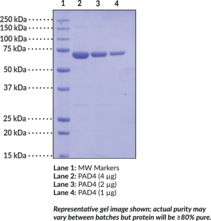
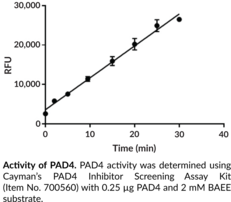
Protein arginine deiminase 4 (PAD4) catalyzes the conversion of arginine residues to citrulline within cellular protein substrates, resulting in the loss of a positive charge, which can alter protein structure and/or function.1 It is expressed in neutrophils, as well as a variety of tissues, including the brain, liver, lung, and kidney.1,2,3 PAD4 has a key role in NETosis, a lytic form of cell death characterized by the release of neutrophil extracellular traps (NETs).1 Upon neutrophil activation, PAD4 translocates to the nucleus where it citrullinates histones, initiating chromatin decondensation and the release of NETs.2,4,5 Neutrophils isolated from Pad4-/- mice exhibit decreased citrullination of histone H3 under both basal and LPS-stimulated conditions and are defective for NET formation in response to stimulation with LPS, phorbol 12-myristate 13-acetate (PMA; Item No. 10008014), or hydrogen peroxide.4 Pad4-/- mice exhibit larger lesions than wild-type mice in a model of necrotizing fasciitis induced by M1 group A S. pyogenes lacking the extracellular DNase Sda1. Pad4-deficient mice also exhibit reduced infarct size in a model of myocardial ischemia-reperfusion injury and reduced tumor growth in a Lewis lung carcinoma model.6,2 PADI4 SNPs, including G55S, V82A, and G112A, are associated with rheumatoid arthritis in humans.7 Cayman’s PAD4 (human, recombinant) protein contains the G55S, V82A, and G112A SNPs and can be used for enzyme activity assays.
WARNING This product is not for human or veterinary use.
References & Product Citations
1. Peptidylarginine deiminase expression and activity in PAD2 knock-
2. Priming of neutrophils toward NETosis promotes tumor growth. Oncoimmunology 5(5), e1134073 (2016).
3. Protein arginine deiminase 4 (PAD4): Current understanding and future therapeutic potential. Curr. Opin. Drug Discov. Devel. 12(5), 616-627 (2009).
4. PAD4 is essential for antibacterial innate immunity mediated by neutrophil extracellular traps. J. Exp. Med. 207(9), 1853-1862 (2010).
5. NETosis proceeds by cytoskeleton and endomembrane disassembly and PAD4-
6. VWF-
7. Functional haplotypes of PADI4, encoding citrullinating enzyme peptidylarginine deiminase 4, are associated with rheumatoid arthritis. Nat. Genet. 34(4), 395-402 (2003).
Internally quenched fluorescent peptides provide insights into underexplored and reversible post-
Citrullination of TDP-
Citrullination of C1-
Cryoelectron tomography reveals the multiplex anatomy of condensed native chromatin and its unfolding by histone citrullination. Mol. Cell. 83(18), 3236-3252 (2023).
Citrullination of myelin basic protein induces a Th17-
Citrullination of α2-
Inhibition of netosis with PAD inhibitor attenuates endotoxin shock induced systemic inflammation. Int. J. Mol. Sci. 23(21), 13264 (2022).
Untargeted metabolomic profiling identifies disease-
Applicability of small-
Citrullination of fibrinogen by peptidylarginine deiminase 2 impairs fibrin clot structure. Clin. Chim. Acta 501, 6-11 (2020).
Quantification of citrullinated histones: Development of an improved assay to reliably quantify nucleosomal H3Cit in human plasma. J. Thromb. Haemost. 18(10), 2732-2743 (2020).
Relative efficiencies of peptidylarginine deiminase 2 and 4 in generating target sites for anti-
Validation of an enzyme-
Contact Info
Cayman Chemical1180 East Ellsworth RoadAnn Arbor, Michigan 48108 USAToll Free: (800) 364-9897(USA and Canada only)Fax: (734) 971-3640


