Pure human recombinant enzyme
Technical Support & Resources

Visit our FAQ

Contact Us

Toll Free Phone (USA and Canada Only): (888) 526-5351
Direct Phone: (734) 975-3888

Request Technical Support

Technical Support Request

To streamline the process attach the appropriate questionnaire to your inquiry.

Download IHC QuestionnaireDownload WB Questionnaire

View Our Privacy Statement for details on how we use and protect your data. In addition, this site is protected by hCaptcha and its Privacy Policy and Terms of Service apply.

UTX (human, recombinant)

Item No. 10774

Technical Information
Synonyms
  • KDM6A
  • Ubiquitously Transcribed Tetratricopeptide Repeat X
Purity
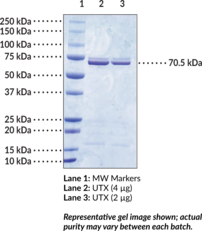
≥55% estimated by SDS-PAGE
Source
Recombinant N-terminal proprietary tagged protein expressed in E. coli
Amino Acids
930-1,410 (N-terminal truncation)
MW
70.5 kDa
Storage Buffer
50 mM Hepes, pH 7.4, containing 150 mM sodium chloride and 20% glycerol
UniProt Accession №
O15550
Shipping & Storage Information
Storage
-80°C
Shipping
Dry ice in continental US; may vary elsewhere
Recommended Products

Certificates of Analysis & Batch Specific Data

Provide batch numbers separated by commas to download or request available product inserts, QC sheets, certificates of analysis, data packs, and GC-MS data.

    Add

    Cayman Chemical
    Visit Our Cancer Resource Center
    Find Tools & Resources to Study the Hallmarks of Cancer
    • Cancer cell signaling & regulation
    • Cancer metabolism
    • Tumor microenvironment
    EXPLORE NOW
    Product Description

    Ubiquitously transcribed tetratricopeptide repeat X (UTX) gene codes for the widely-expressed UTX protein. The UTX gene is localized on the X chromosome and is a homolog of the ubiquitously transcribed mouse Y chromosome (UTY) gene. UTX gene expression has been shown to evade X-chromosome inactivation.1 The JmjC-containing UTX protein is a member of the hydroxylase family of enzymes, which are α-ketoglutarate-dependent Fe (II) oxygenases.2 UTX plays a crucial role in epigenetic regulation of gene expression by catalyzing the demethylation of tri-methylated lysine 27 on histone H3.3 UTX works in opposition to the polycomb repressive complex 2 (PRC2) group protein EZH2, playing a role in cancers with abberant H3K27 methylation.

    WARNING This product is not for human or veterinary use.

    References & Product Citations
    Product Description References

    1. Greenfield, A., Carrel, L., Pennis, D., et alThe UTX gene escapes X inactivation in mice and humans. Hum. Mol. Genet. 7(4), 737-742 (1998).

    2. Hübner, M.R., and Spector, D.L. Role of H3K27 demethylases Jmjd3 and UTX in transcriptional regulation. Cold Spring Harb. Symp. Quant. Biol. 75, 43-49 (2010).

    3. Agger, K., Cloos, P.A.C., Christensen, J., et alUTX and JMJD3 are histone H3K27 demethylases involved in HOX gene regulation and development. Nature 449(7163), 731-734 (2011).