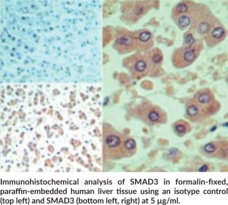
For immunochemical analysis of SMAD3
Technical Support & Resources

Visit our FAQ

Contact Us

Toll Free Phone (USA and Canada Only): (888) 526-5351
Direct Phone: (734) 975-3888
Request Technical Support

Technical Support Request

To streamline the process attach the appropriate questionnaire to your inquiry.

Download IHC QuestionnaireDownload WB Questionnaire

View Our Privacy Statement for details on how we use and protect your data. In addition, this site is protected by hCaptcha and its Privacy Policy and Terms of Service apply.

SMAD3 Polyclonal Antibody

Item No. 10832

Technical Information
Immunogen
Portion of amino acids 100-150 of human SMAD3
100 µg protein G-purified IgG
Storage Buffer
PBS containing 0.05% sodium azide
Host
Rabbit
Applications
IF, IHC, and WB
Species Reactivity
(+) Human(+) Bovine(+) Canine(+) Mouse(+) Porcine(+) Primate(+) Rat
Origin
Animal/Rabbit
Shipping & Storage Information
Storage
4°C
Shipping
Wet ice in continental US; may vary elsewhere
Recommended Products

Certificates of Analysis & Batch Specific Data

Provide batch numbers separated by commas to download or request available product inserts, QC sheets, certificates of analysis, data packs, and GC-MS data.

    Add

    Cayman Chemical
    Visit Our Cancer Resource Center
    Find Tools & Resources to Study the Hallmarks of Cancer
    • Cancer cell signaling & regulation
    • Cancer metabolism
    • Tumor microenvironment
    EXPLORE NOW
    Product Description

    SMAD3, a member of the SMAD family of proteins, is involved in the TGF-β signaling cascade. A human homolog of Drosophila Mad protein, SMAD3 consists of an N-terminal DNA-binding MH1 domain, a linker region and a C-terminal MH2 domain. It is a receptor-regulated SMAD (R-SMAD) that functions downstream of TGF-β and activin receptors and mediates their signaling.1,2 It is recruited by SARA (SMAD anchor for receptor activation) to the receptor kinase for phosphorylation. Upon phosphorylation, SMAD3 dissociates from SARA, forms a complex with SMAD4 and transmigrates into the nucleus where it complexes with other cofactors and acts as a transcription factor. It has an indispensable role in cell proliferation, differentiation, apoptosis and formation of ECM. Loss of SMAD3 results in childhood T cell leukemia.

    WARNING This product is not for human or veterinary use.

    References & Product Citations
    Product Description References

    1. Shi, Y., and Massaro, A.F. Mechanisms of TGF-β signaling from cell membrane to the nucleus. Cell 113, 685-700 (2003).

    2. Qin, B.Y., Suvana, S.L., Correia, J.J., et alSmad3 allostery links TGF-β receptor kinase activation to transcriptional control. Genes Dev. 16, 1950-1953 (2002).

    Product Citations

    Upadhyay, A.K., Chattopadhyay, P., Goyary, D., et alIxora Coccinea enhances cutaneous wound healing by upregulating the expression of collagen and basic fibroblast growth factor. ISRN Pharmacol. 2014, 751824 (2014).