
Technical Support & Resources
Information provided in the product description is from published literature. Due to the nature of scientific experimentation, your results (e.g., selectivity and effective concentrations) or specific application for this product may differ. If you have questions about how this product fits your application, please contact our technical support staff.
Visit our FAQ
Contact Us
Toll Free Phone (USA and Canada Only): (888) 526-5351
Direct Phone: (734) 975-3888

Technical Information
Shipping & Storage Information
Recommended Products
Certificates of Analysis & Batch Specific Data
Provide batch numbers separated by commas to download or request available product inserts, QC sheets, certificates of analysis, data packs, and GC-MS data.
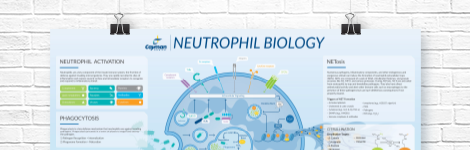
Neutrophil Biology Wall Poster
Explore how neutrophils shape the immune response in health and disease. This poster highlights neutrophil pathogen defense mechanisms, including phagocytosis, degranulation, and NETosis, as well as neutrophil roles in inflammation and NET-associated pathologies.
DOWNLOAD NOWProduct Description
Retinoic-acid-receptor-related orphan receptors (ROR) α and γ play a key role in the development of T-helper cells that produce interleukin-17 (TH17 cells), a subset of CD4+ T-cells that contribute to the inflammatory process and have been implicated in the pathology of autoimmune diseases. SR 1001 is a synthetic ligand specific for RORα and RORγ (Kis = 172 and 111 nM, respectively) that functions as an inverse agonist at these receptors.1 SR 1001 has been shown to suppress IL-17 promoter driven transcriptional activity by inhibiting the interaction of co-activators such as TRAP220 nuclear receptor box 2 peptide (IC50 = 117 nM) and SRC2 with RORα and RORγ as well as by increasing the recruitment of corepressors such as NCoR. At 5 μM, SR 1001 inhibits TH17 cell differentiation and IL-17A secretion in cultured splenocytes and human PBMCs. A 25 mg/kg dose of SR 1001 twice/day delays the onset and the severity of experimental autoimmune encephalomyelitis, a mouse model of multiple sclerosis.1
WARNING This product is not for human or veterinary use.
References & Product Citations
1. Suppression of TH17 differentiation and autoimmunity by a synthetic ROR ligand. Nature 472(7344), 491-494 (2011).
Contact Info
Cayman Chemical1180 East Ellsworth RoadAnn Arbor, Michigan 48108 USAToll Free: (800) 364-9897(USA and Canada only)Fax: (734) 971-3640


