
Technical Support & Resources
Visit our FAQ
Contact Us
Toll Free Phone (USA and Canada Only): (888) 526-5351
Direct Phone: (734) 975-3888
Product Categories
Product Type
Technical Information
Shipping & Storage Information
Recommended Products
Certificates of Analysis & Batch Specific Data
Provide batch numbers separated by commas to download or request available product inserts, QC sheets, certificates of analysis, data packs, and GC-MS data.
Lipid Resource Center
Discover Products & Resources for Lipid Research
- High-purity lipid standards
- Lipid roles in biology
- Lipids in health & disease
- Lipids for pharmaceutical development
- Protocols, advice, & resources
Product Description
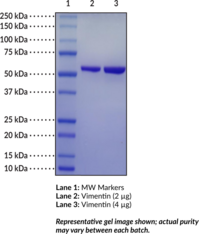
Vimentin is a cytoskeleton intermediate filament protein present in cells of mesenchymal origin, including leukocytes, endothelial cells, and smooth muscle cells.1 Each vimentin monomer contains a central α-helix that facilitates formation of the coil-coil dimer required for vimentin filament assembly.2 Vimentin is attached to nuclei, endoplasmic reticulum, and mitochondria, and has a role in positioning organelles in the cytosol. It regulates glial morphology, facilitates motility and directional migration of fibroblasts, and is critical to mechanotransduction of shear stress and maintenance of vascular endothelial integrity.1 Vimentin controls transport of LDL-derived cholesterol from lysosomes to esterification sites.3 It is an aggresome component, forming a cage-like structure around aggregated, undegraded proteins at the microtubule organizing center.4 Vimentin is subject to citrullination under high calcium concentrations, which can occur during macrophage apoptosis, and citrullinated vimentin has been shown to have a role in the production of anti-citrullinated protein antibodies (ACPAs).5,6 ACPAs against citrullinated proteins, such as vimentin, are considered to be highly specific markers for rheumatoid arthritis and other autoimmune diseases.5
WARNING This product is not for human or veterinary use.
References & Product Citations
1. Introducing intermediate filaments: From discovery to disease. J. Clin. Invest. 119(7), 1763-1771 (2009).
2. Assembling an intermediate filament network by dynamic cotranslation. J. Cell. Biol. 172(5), 747-758 (2006).
3. A functional role for vimentin intermediate filaments in the metabolism of lipoprotein-
4. Aggresomes: A cellular response to misfolded proteins. J. Cell Biol. 143(7), 1883-1898 (1998).
5. Clinical evaluation of anti-
6. Selective deimination of vimentin in calcium ionophore-
Astrocytic calcium-
Citrullinated vimentin and alpha enolase are expressed at the cell surface of apoptotic human neutrophils. Hum. Immunol. 87(1), 111631 (2026).
Cytotoxic CD8+ T cells target citrullinated antigens in rheumatoid arthritis. Nat. Commun. 14(1), 319 (2023).
Contact Info
Cayman Chemical1180 East Ellsworth RoadAnn Arbor, Michigan 48108 USAToll Free: (800) 364-9897(USA and Canada only)Fax: (734) 971-3640


