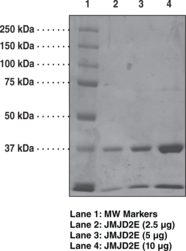
Host: E. coli • AA: 2-337 • Tag: N-terminal Strep II • MW: 40.8 kDa
Technical Support & Resources

Visit our FAQ

Contact Us

Toll Free Phone (USA and Canada Only): (888) 526-5351
Direct Phone: (734) 975-3888

Request Technical Support

Technical Support Request

To streamline the process attach the appropriate questionnaire to your inquiry.

Download IHC QuestionnaireDownload WB Questionnaire

View Our Privacy Statement for details on how we use and protect your data. In addition, this site is protected by hCaptcha and its Privacy Policy and Terms of Service apply.

JMJD2E Strep-tagged (human, recombinant)

Item No. 11237

Product Insert (PDF)
Technical Information
Synonyms
  • Jumonji Domain Containing 2E
  • KDM4D-Like
Purity
≥75% estimated by SDS-PAGE
Source
active recombinant N-terminal Strep II-tagged protein expressed in E. coli
Amino Acids
2-337
MW
40.8 kDa
20 mM HEPES, pH 7.4, and 150 mM sodium chloride
License
Sold under license from IBA.
UniProt Accession №
B2RXH2
Shipping & Storage Information
Storage
-80°C
Shipping
Dry ice in continental US; may vary elsewhere
Certificates of Analysis & Batch Specific Data

Provide batch numbers separated by commas to download or request available product inserts, QC sheets, certificates of analysis, data packs, and GC-MS data.

    Add

    Cayman Chemical
    Visit Our Cancer Resource Center
    Find Tools & Resources to Study the Hallmarks of Cancer
    • Cancer cell signaling & regulation
    • Cancer metabolism
    • Tumor microenvironment
    EXPLORE NOW
    Product Description

    Methylation of lysine residues in core histones plays a critical role in regulating gene expression.1 Jumonji domain containing 2E (JMJD2E) catalyzes the demethylation of histone H3 at lysince residue 9.2 Like other JmjC protein hydroxylase family members, JMJD2E is an α-ketoglutarate-dependent Fe (II) oxygenase.3 Purification of Fe-dependent JmjC family members by IMAC can result in displacement of the catalytic iron and decreased activity, therefore this Strep-tagged protein is purified by affinity chromatography using Strep-Tactin coated resin.4 Because of their implication in cancer cell growth, jumonji C domain-containing histone demethylase inhibitors may have the capacity to be anticancer agents.1

    WARNING This product is not for human or veterinary use.

    References & Product Citations
    Product Description References

    1. Hamada, S., Kim, T.D., Suzuki, T., et alSynthesis and activity of N-oxalylglycine and its derivatives as Jumonji C-domain-containing histone lysine demethylase inhibitors. Bioorg. Med. Chem. Lett. 19(10), 2852-2855 (2009).

    2. Kouzarides, T. Chromatin modifications and their function. Cell 128(4), 693-705 (2007).

    3. Couture, J.-F., Collazo, E., Ortiz-Tello, P.A., et alSpecificity and mechanism of JMJD2A, a trimethyllysine-specific histone demethylase. Nat. Struct. Mol. Biol. 14(8), 689-695 (2007).

    4. Krishnan, S., Collazo, E., Ortiz-Tello, P.A., et alPurification and assay protocols for obtaining highly active Jumonji C demethylases. Anal. Biochem. 420(1), 48-53 (2012).