
Technical Support & Resources
Information provided in the product description is from published literature. Due to the nature of scientific experimentation, your results (e.g., selectivity and effective concentrations) or specific application for this product may differ. If you have questions about how this product fits your application, please contact our technical support staff.
Visit our FAQ
Contact Us
Toll Free Phone (USA and Canada Only): (888) 526-5351
Direct Phone: (734) 975-3888
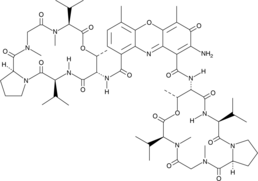
Technical Information
- ActD
- Actinomycin C1
- Dactinomycin
- Meractinomycin
- NCI C04682
- NSC 3053
- Oncostatin K
Shipping & Storage Information
Recommended Products
Certificates of Analysis & Batch Specific Data
Provide batch numbers separated by commas to download or request available product inserts, QC sheets, certificates of analysis, data packs, and GC-MS data.

Visit Our Cancer Resource Center
Find Tools & Resources to Study the Hallmarks of Cancer
- Cancer cell signaling & regulation
- Cancer metabolism
- Tumor microenvironment
Product Description
Actinomycin D is an antitumor antibiotic that has been found in Streptomyces and has diverse biological activities.1,2,3,4,5,6 It binds to replicating DNA at the transcription initiation complex and inhibits RNA polymerase elongation.1,2 It induces apoptosis in PANC-1 pancreatic cancer, MG-63 osteosarcoma, and patient-derived chronic lymphocytic leukemia (CLL) cells.3,4,5 Actinomycin D (0.06 mg/kg, i.p.) reduces tumor load and increases survival in a TCL1 transgenic mouse model of high-risk CLL.5 It is active against B. cereus, S. pneumoniae, and methicillin-susceptible S. aureus (MICs = 3.125, 12.5, and 6.25 µg/ml, respectively), as well as multiple strains of methicillin-resistant S. aureus (MRSA; MICs = 12.5-25 µg/ml).6 Formulations containing actinomycin D have been used in the treatment of cancer.
WARNING This product is not for human or veterinary use.
References & Product Citations
1. Force spectroscopy reveals the DNA structural dynamics that govern the slow binding of Actinomycin D. Nucleic Acids Res. 40(11), 4925-4932 (2012).
2. Actinomycin and DNA transcription. Proc. Natl. Acad. Sci. USA 82, 5328-5331 (1985).
3. Actinomycin D induces apoptosis and inhibits growth of pancreatic cancer cells. Int. J. Cancer 86(3), 399-407 (2000).
4. Actinomycin D inhibits cell proliferations and promotes apoptosis in osteosarcoma cells. Int. J. Clin. Exp. Med. 8(2), 1904-1911 (2015).
5. Actinomycin D induces p53-
6. Isolation, characterization, anti-
Adenovirus prevents dsRNA formation by promoting efficient splicing of viral RNA. Nucleic Acids Res. 50(3), 1201-1220 (2022).
Cyclodextrin-
Gold nanorods exhibit intrinsic therapeutic activity via controlling N6-
Saikosaponin D exhibits anti-
A dynamic N6-
Contact Info
Cayman Chemical1180 East Ellsworth RoadAnn Arbor, Michigan 48108 USAToll Free: (800) 364-9897(USA and Canada only)Fax: (734) 971-3640


