
Technical Support & Resources
Visit our FAQ
Contact Us
Toll Free Phone (USA and Canada Only): (888) 526-5351
Direct Phone: (734) 975-3888
Product Categories
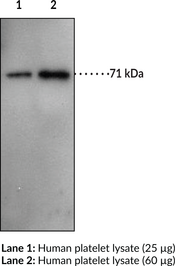
Prostaglandin Transporter (C-Term) Polyclonal Antibody
Item No. 11860
Technical Information
- OATP2A1
- PGT
- SLCO2A1
- Solute carrier organic anion transporter family member 2A1
Shipping & Storage Information
Recommended Products
Certificates of Analysis & Batch Specific Data
Provide batch numbers separated by commas to download or request available product inserts, QC sheets, certificates of analysis, data packs, and GC-MS data.
Lipid Resource Center
Discover Products & Resources for Lipid Research
- High-purity lipid standards
- Lipid roles in biology
- Lipids in health & disease
- Lipids for pharmaceutical development
- Protocols, advice, & resources
Product Description
Prostaglandins (PGs) are signaling molecules that modulate physiological or pathologic functions such as platelet aggregation, vascular tone, gastric cytoprotection, uterine contraction, inflammation, cancer and Alzheimer’s disease.1,2,3,4,5,6 PG transporter (PGT) is generally expressed in endothelial and epithelial cells. Transport of extracellular PGs into cells occurs via a specific PGT, allowing PG oxidation by 15-
WARNING This product is not for human or veterinary use.
References & Product Citations
1. Prostaglandins. Annu. Rev. Biochem. 44, 669-695 (1975).
2. Role of prostaglandins in regulation of gastric mucosal blood flow and acid secretion. Am. J. Physiol. 263(4 Pt 1), G446-G451 (1992).
3. Prostaglandins and sex steroids from corpora leutea of pregnant mares. In vitro studies. Prostaglandins 48(4), 262-272 (1994).
4. Prostaglandins as modulators of immunity. Trends Immunol. 23(3), 144-150 (2002).
5. Prostaglandins as inflammatory messengers across the blood-
6. Mixed messages: Modulation of inflammation and immune responses by prostaglandins and thromboxanes. J. Clin. Invest. 108(1), 15-23 (2001).
7. Identification and characterization of a prostaglandin transporter. Science 268(5212), 866-869 (1995).
8. Cloning, in vitro expression, and tissue distribution of a human prostaglandin transporter cDNA (hPGT). J. Clin. Invest. 98(5), 1142-1149 (1996).
9. The prostaglandin transporter regulates adipogenesis and Aromatase transcription. Cancer Prev. Res. (Phila.) 4(2), 194-206 (2011).
10. Tricine-
Contact Info
Cayman Chemical1180 East Ellsworth RoadAnn Arbor, Michigan 48108 USAToll Free: (800) 364-9897(USA and Canada only)Fax: (734) 971-3640


