
Technical Support & Resources
Visit our FAQ
Contact Us
Toll Free Phone (USA and Canada Only): (888) 526-5351
Direct Phone: (734) 975-3888
Product Categories
Application
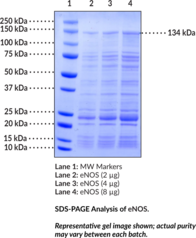
eNOS (bovine, recombinant; E. coli expressed)
Item No. 11868
Technical Information
- Constitutive NOS
- cNOS
- Endothelial Nitric Oxide Synthase
- Endothelial NOS
- Nitric Oxide Synthase 3
Shipping & Storage Information
Recommended Products
Certificates of Analysis & Batch Specific Data
Provide batch numbers separated by commas to download or request available product inserts, QC sheets, certificates of analysis, data packs, and GC-MS data.
Product Description
Endothelial nitric oxide synthase (eNOS), also known as NOS3, converts arginine to citrulline and nitric oxide (NO) to regulate endothelial homeostasis and vascular tone.1,2,3 It is composed of an N-terminal oxygenase domain that contains binding sites for its substrate L-arginine (Item No. 23703), heme, and the cofactor tetrahydrobiopterin (BH4) and a reductase domain with binding sites for NADPH, flavin mononucleotide, flavin-adenine dinucleotide, and calmodulin.3 eNOS is expressed in endothelial cells, as well as blood cells and circulating microparticles, with expression levels changing in response to growth factors, cytokines, and mechanical stimulation.1,2 Localization of eNOS is mediated by protein fatty acid acylation, with myristoylated and palmitoylated eNOS targeted to plasma membrane caveolae and the Golgi complex. eNOS functions as a homodimer and is activated by the binding of calcium-bound calmodulin. eNOS uncoupling and dysfunction, primarily induced by the loss of BH4 due to oxidation or decreased expression of dihydrofolate reductase (DHFR), induces the production of superoxide in place of NO and is a hallmark of most cardiovascular diseases, including atherosclerosis.4,5 Cayman's eNOS (bovine, recombinant; E. coli expressed) can be used for enzyme assay applications.
WARNING This product is not for human or veterinary use.
References & Product Citations
1. Post-
2. Central role of eNOS in the maintenance of endothelial homeostasis. Antioxid. Redox Signal. 22(14), 1230-1242 (2015).
3. The eNOS signalosome and its link to endothelial dysfunction. Pflugers Arch. 468(7), 1125-1137 (2016).
4. New therapeutic implications of endothelial nitric oxide synthase (eNOS) function/dysfunction in cardiovascular disease. Int. J. Mol. Sci. 20(1), 187 (2019).
5. Nitric oxide synthase uncoupling: A therapeutic target in cardiovascular diseases. Vascul. Pharmacol. 57(5-6), 168-172 (2012).
2-
Contact Info
Cayman Chemical1180 East Ellsworth RoadAnn Arbor, Michigan 48108 USAToll Free: (800) 364-9897(USA and Canada only)Fax: (734) 971-3640


