
Features
- Due to limited shelf life and/or restricted production, this product is available as custom order only. Please contact our sales office for pricing and lead time.
Technical Support & Resources
Visit our FAQ
Contact Us
Toll Free Phone (USA and Canada Only): (888) 526-5351
Direct Phone: (734) 975-3888
Product Categories
Product Type
Technical Information
- ORC1L
- Origin Recognition Complex Subunit 1
- PARC1
- Replication Control Protein 1
Shipping & Storage Information
Recommended Products
Certificates of Analysis & Batch Specific Data
Provide batch numbers separated by commas to download or request available product inserts, QC sheets, certificates of analysis, data packs, and GC-MS data.
Product Description
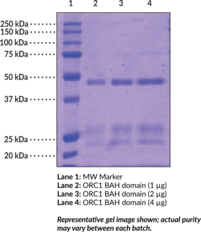
ORC1, a component of the Origin Recognition Complex, is necessary for the initiation of DNA replication. It is bound in complex with ORC2, ORC3, ORC4, ORC5, and ORC6. The BromoAdjacent Homology (BAH) domain of ORC1 recognizes histone 4 dimethylated at lysine 20, which is enriched at replication origins (ORI).1 Chromatin immunoprecipitation and parallel sequencing of ORC1 DNA binding sites has been used to identify the ORI sites in HeLa cells.2 In addition to BAH mediated nucleosome recognition, ORC1 contains ATPase activity which is required for loading the minichromosome maintenance helicase complex.3 ORC1 levels oscillate during the cell cycle, decreasing during S phase following formation of pre-
WARNING This product is not for human or veterinary use.
References & Product Citations
1. The BAH domain of ORC1 links H4K20me2 to DNA replication licensing and Meier-
2. Genome-
3. An ORC/Cdc6/MCM2-
4. The ORC1 cycle in human cells: I. Cell cycle-
5. Mechanisms and pathways of growth failure in primordial dwarfism. Genes Dev. 25(19), 2011-2024 (2011).
Contact Info
Cayman Chemical1180 East Ellsworth RoadAnn Arbor, Michigan 48108 USAToll Free: (800) 364-9897(USA and Canada only)Fax: (734) 971-3640


