
Technical Support & Resources
Visit our FAQ
Contact Us
Toll Free Phone (USA and Canada Only): (888) 526-5351
Direct Phone: (734) 975-3888
ApoA1 Monoclonal Antibody (Clone CC3821C4)
Item No. 13042
Technical Information
- Apolipoprotein A1
Shipping & Storage Information
Recommended Products
Certificates of Analysis & Batch Specific Data
Provide batch numbers separated by commas to download or request available product inserts, QC sheets, certificates of analysis, data packs, and GC-MS data.
Product Description
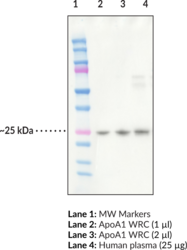
ApoA1 is a major protein component in high-density lipoproteins (HDLs). It acts as an acceptor for sequential transfers of phospholipids and free cholesterol from peripheral tissues and transports cholesterol to the liver and other tissues for excretion and steroidogenesis.1 Serum ApoA1 levels are inversely related to the risk of developing atherosclerosis.2 Loss-of-function mutations are causes of diseases such as HDL deficiency type 1 (or Tangier disease) and type 2 (familial hypoalphalipoproteinemia), and systemic non-neuropathic amyloidosis.3,4 Liver and small intestine are two main sources of the protein. ApoA1 is comprised of a single polypeptide chain of 243 amino acid residues with an estimated molecular weight of 28 kDa. Cayman’s ApoA1 Monoclonal Antibody detects the protein from diluted human plasma (≤10 µg total protein) by western blotting. Western blotting of recombinant ApoA1 samples suggest a detection limit of 5 ng.
WARNING This product is not for human or veterinary use.
References & Product Citations
1. .
2. .
3. .
4. .
Contact Info
Cayman Chemical1180 East Ellsworth RoadAnn Arbor, Michigan 48108 USAToll Free: (800) 364-9897(USA and Canada only)Fax: (734) 971-3640


