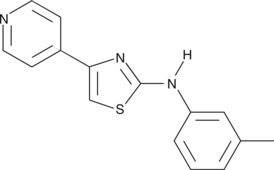
Inducer of autophagy in renal cell carcinoma cells
Technical Support & Resources

Information provided in the product description is from published literature. Due to the nature of scientific experimentation, your results (e.g., selectivity and effective concentrations) or specific application for this product may differ. If you have questions about how this product fits your application, please contact our technical support staff.

Visit our FAQ

Contact Us

Toll Free Phone (USA and Canada Only): (888) 526-5351
Direct Phone: (734) 975-3888

Request Technical Support

Technical Support Request

To streamline the process attach the appropriate questionnaire to your inquiry.

Download IHC QuestionnaireDownload WB Questionnaire

View Our Privacy Statement for details on how we use and protect your data. In addition, this site is protected by hCaptcha and its Privacy Policy and Terms of Service apply.

STF-62247

Item No. 13084

Technical Information
Formal Name
N-(3-methylphenyl)-4-(4-pyridinyl)-2-thiazolamine
CAS Number
315702-99-9
Molecular Formula
C15H13N3S
Formula Weight
Purity
≥98%
A crystalline solid
DMF: 25 mg/mlDMSO: 25 mg/mlDMSO:PBS (pH 7.2)(1:5): 0.2 mg/ml
λmax
246, 296 nm
SMILES
Cc1cccc(c1)Nc1scc(n1)c1ccncc1
InChi Code
InChI=1S/C15H13N3S/c1-11-3-2-4-13(9-11)17-15-18-14(10-19-15)12-5-7-16-8-6-12/h2-10H,1H3,(H,17,18)
InChi Key
KATNUHQNJGNLPW-UHFFFAOYSA-N
Shipping & Storage Information
Storage
-20°C
Shipping
Room temperature in continental US; may vary elsewhere
Recommended Products

Certificates of Analysis & Batch Specific Data

Provide batch numbers separated by commas to download or request available product inserts, QC sheets, certificates of analysis, data packs, and GC-MS data.

    Add

    Add

    Add

    Add

    Cayman Chemical
    Visit Our Cancer Resource Center
    Find Tools & Resources to Study the Hallmarks of Cancer
    • Cancer cell signaling & regulation
    • Cancer metabolism
    • Tumor microenvironment
    EXPLORE NOW
    Product Description

    STF-62247 is a small molecule agonist that induces autophagy and selectively causes lethality in renal cell carcinoma (RCC) cells that have lost the von Hippel-Lindau (VHL) tumor suppressor activity (IC50 = 625 nM).1 It significantly reduces the growth rate of tumors formed from VHL-deficient cells in mice.1,2,3 STF-62247 induces cytotoxicity in VHL-positive RCC cells only at higher concentrations (IC50 = 16 μM).1

    WARNING This product is not for human or veterinary use.

    References & Product Citations
    Product Description References

    1. Turcotte, S., Sutphin, P.D., and Giaccia, A.J. Targeting therapy for the loss of von Hippel-Lindau in renal cell carcinoma a novel molecule that induces autophagic cell death. Autophagy 4(7), 944-946 (2008).

    2. Turcotte, S., Chan, D.A., Sutphin, P.D., et alA molecule targeting VHL-deficient renal cell carcinoma that induces autophagy. Cancer Cell 14(1), 90-102 (2008).

    3. Chan, D.A., and Giaccia, A.J. Targeting cancer cells by synthetic lethality autophagy and VHL in cancer therapeutics. Cell Cycle 7(19), 2987-2990 (2008).

    Product Citations

    Selka, A., Doiron, J.A., Lyons, P.A., et alDiscovery of a novel 2,5-dihydroxycinnamic acid-based 5-lipoxygenase inhibitor that induces apoptosis and may impair autophagic flux in RCC4 renal cancer cells. Eur. J. Med. Chem. 179, 347-357 (2019).