
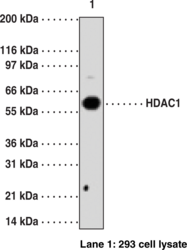
For immunochemical detection of HDAC1
Technical Support & Resources

Visit our FAQ

Contact Us

Toll Free Phone (USA and Canada Only): (888) 526-5351
Direct Phone: (734) 975-3888
Request Technical Support

Technical Support Request

To streamline the process attach the appropriate questionnaire to your inquiry.

Download IHC QuestionnaireDownload WB Questionnaire

View Our Privacy Statement for details on how we use and protect your data. In addition, this site is protected by hCaptcha and its Privacy Policy and Terms of Service apply.

HDAC1 Polyclonal Antibody

Item No. 13491

Technical Information
Synonyms
  • Histone Deactylase 1
Immunogen
synthetic peptides corresponding to amino acids 1-5, 433-448 and 467-482 of human HDAC1
100 µg of protein G-purified IgG in 200 µl PBS containing 0.02% sodium azide
Host
Rabbit
Applications
WB
Species Reactivity
(+) Human HDAC1
Origin
Animal/Rabbit
Shipping & Storage Information
Storage
-20°C
Shipping
Wet ice in continental US; may vary elsewhere
Recommended Products

Certificates of Analysis & Batch Specific Data

Provide batch numbers separated by commas to download or request available product inserts, QC sheets, certificates of analysis, data packs, and GC-MS data.

    Add

    Cayman Chemical
    Visit Our Cancer Resource Center
    Find Tools & Resources to Study the Hallmarks of Cancer
    • Cancer cell signaling & regulation
    • Cancer metabolism
    • Tumor microenvironment
    EXPLORE NOW
    Product Description

    Histone deacetylase (HDAC) and histone acetyltransferase (HAT) are enzymes that regulate transcription by selectively deacetylating or acetylating the ε-amino groups of lysines located near the amino termini of core histone proteins.1 Eleven members of HDAC family have been identified in the past several years.2,3 These HDAC family members are divided into two classes, I and II. HDAC1 is a Class I HDAC which is related to the yeast HDAC Rpd3.4 It is primarily localized to the nucleus with ubiquitous distribution throughout human cell lines and tissues. By modifying chromatin structure and other non-histone proteins, HDACs play important roles in controlling complex biological events, including cell development, differentiation, programmed cell death, angiogenesis, and inflammation. Considering these major roles, it is conceivable that dysregulation of HDACs and subsequent imbalance of acetylation and deacetylation may be involved in the pathogenesis of various diseases, including cancer and inflammatory diseases.4

    WARNING This product is not for human or veterinary use.

    References & Product Citations
    Product Description References

    1. Meinke, P.T., and Liberator, P. Histone deacetylase: A target for antiproliferative and antiprotozoal agents. Curr. Med. Chem. 8(2), 211-235 (2001).

    2. Nakayama, T., and Takami, Y. Participation of histones and histone-modifying enzymes in cell functions through alterations in chromatin structure. J. Biochem. 129, 491-499 (2001).

    3. Cress, W.D., and Seto, E.J. Histone deacetylases, transcriptional control, and cancer. J. Cell. Physiol. 184, 1-16 (2000).

    4. Huang, L. Targeting histone deacetylases for the treatment of cancer and inflammatory diseases. J. Cell. Physiol. 209(3), 611-616 (2006).

