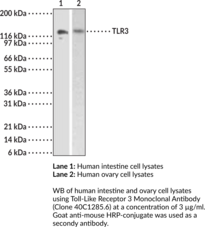
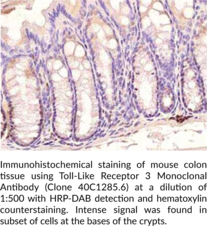
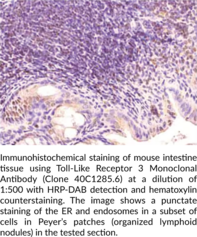
For immunochemical analysis of TLR3
Technical Support & Resources

Visit our FAQ

Contact Us

Toll Free Phone (USA and Canada Only): (888) 526-5351
Direct Phone: (734) 975-3888

Request Technical Support

Technical Support Request

To streamline the process attach the appropriate questionnaire to your inquiry.

Download IHC QuestionnaireDownload WB Questionnaire

View Our Privacy Statement for details on how we use and protect your data. In addition, this site is protected by hCaptcha and its Privacy Policy and Terms of Service apply.

Toll-Like Receptor 3 Monoclonal Antibody (Clone 40C1285.6)

Item No. 13588

Technical Information
Synonyms
  • TLR3
Immunogen
Human TLR3 of amino acids 55-70
Clone Designation
40C1285.6
100 µg of protein G-purified Monoclonal Antibody
Storage Buffer
PBS, with 0.05% sodium azide
Host
Mouse
Isotype
IgG1κ
Applications
FC (intracellular and cell surface), ICC, IHC, IP, WB
Cross Reactivity
(+) Human TLR3(+) Canine TLR3
Species Reactivity
(+) Human TLR3(+) Canine TLR3
Origin
Animal/Mouse
Shipping & Storage Information
Storage
-20°C
Shipping
Wet ice in continental US; may vary elsewhere
Recommended Products

Certificates of Analysis & Batch Specific Data

Provide batch numbers separated by commas to download or request available product inserts, QC sheets, certificates of analysis, data packs, and GC-MS data.

    Add

    Cayman Chemical
    Neutrophil Biology Wall Poster

    Explore how neutrophils shape the immune response in health and disease. This poster highlights neutrophil pathogen defense mechanisms, including phagocytosis, degranulation, and NETosis, as well as neutrophil roles in inflammation and NET-associated pathologies.

    DOWNLOAD NOW
    Product Description

    The toll-like receptors (TLRs) in mammals comprise a family of transmembrane proteins characterized by multiple copies of leucine rich repeats in the extracellular domain and an interleukin-1 (IL-1) receptor motif in the cytoplasmic domain. Like their counterparts in Drosophila, TLRs signal through adaptor molecules.1 The TLR family is a phylogenetically conserved mediator of innate immunity that is essential for microbial recognition.2 Most mammalian species have between ten and fifteen types of TLRs. Ten functional TLRs (TLR1-10) have been identified in human. Humans also encode a TLR11 gene but it contains several stop codons and protein is not expressed. However, mouse and rat TLR11 are functional, and it is thought that human TLR11 function was lost during evolution. Historically speaking, TLR expression has been most extensively studied in the immune system. Overall, TLRs are highly expressed in immune competent cells, including macrophages, dendritic cells, neutrophils, mucosal epithelial cells and dermal endothelial cells. However, TLRs have also been identified in many other cell types and anatomical tissue locations where they are expressed either constitutively or induced during infection. TLR3 cDNA codes for a protein with approximate molecular weight of 120 kDa.3 TLR3 has a restricted expression pattern being expressed in dendritic cells (DC).3,4,5 The expression of TLR3 in a single cell type may indicate a specific role for this molecule in a restricted setting.

    WARNING This product is not for human or veterinary use.

    References & Product Citations
    Product Description References

    1. Srivastava, M.D., and Srivastava, B.I.S. Expression of mRNA and proteins for toll-like receptors, associated molecules, defensins and LL-37 by SRIK-NKL, a CD8+ NK/T cell line. Leuk. Res. 29(7), 813-820 (2005).

    2. Gibson, F.C., Hong, C., Chou, H.H., et alInnate immune recognition of invasive bacteria accelerates atherosclerosis in apolipoprotein E-deficient mice. Circulation 109(22), 2801-2806 (2004).

    3. Furrie, E., Macfarlane, S., Thomson, G., et alToll-like receptors-2, -3 and -4 expression patterns on human colon and their regulation by mucosal-associated bacteria. Immunology 115(4), 565-574 (2005).

    4. Schneeman, T.A., Bruno, M.E.C., Schjerven, H., et alRegulation of the polymeric Ig receptor by signaling through TLRs 3 and 4: Linking innate and adaptive immune responses. J. Immunol. 175(1), 376-384 (2005).

    5. Matsumoto, M., Funami, K., Tanabe, M., et alSubcellular localization of toll-like receptor 3 in human dendritic cells. J. Immunol. 171(6), 3154-3162 (2003).