
Technical Support & Resources
Information provided in the product description is from published literature. Due to the nature of scientific experimentation, your results (e.g., selectivity and effective concentrations) or specific application for this product may differ. If you have questions about how this product fits your application, please contact our technical support staff.
Visit our FAQ
Contact Us
Toll Free Phone (USA and Canada Only): (888) 526-5351
Direct Phone: (734) 975-3888
Product Categories
Research Area
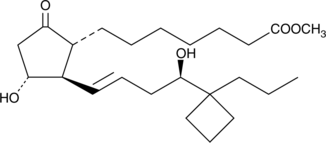
Technical Information
- (±)-15-deoxy-16R-hydroxy-17-cyclobutyl PGE1 methyl ester
- 15-deoxy-16R-hydroxy-17-cyclobutyl PGE1 methyl ester
- TR 4978
Shipping & Storage Information
Recommended Products
Certificates of Analysis & Batch Specific Data
Provide batch numbers separated by commas to download or request available product inserts, QC sheets, certificates of analysis, data packs, and GC-MS data.
Lipid Resource Center
Discover Products & Resources for Lipid Research
- High-purity lipid standards
- Lipid roles in biology
- Lipids in health & disease
- Lipids for pharmaceutical development
- Protocols, advice, & resources
Product Description
Butaprost is a structural analog of prostaglandin E2 (PGE2) with good selectivity for the EP2 receptor subtype. Butaprost has frequently been used to pharmacologically define the EP receptor expression profile of various human and animal tissues and cells.1,2 Serious confusion as to the structure of butaprost was generated by Gardiner in 1986, when he reported that the epimer of butaprost showing this selective activity was the C-16 (R)-epimer (See Note).3 Butaprost binds with about 1/10 the affinity of PGE2 to the recombinant murine EP2 receptor, and does not bind appreciably to any of the other murine EP receptors or DP, FP, IP, or TP receptors.4 The pharmacology of (R)-
WARNING This product is not for human or veterinary use.
References & Product Citations
1. Investigation of the prostaglandin E (EP-
2. Characterization of the PGE receptor subtype mediating inhibition of superoxide production in human neutrophils. Br. J. Pharmacol. 114(7), 1459-1465 (1995).
3. Characterization of prostanoid relaxant/inhibitory receptors (XyX) using a highly selective agonist, TR4979. Br. J. Pharmacol. 87(1), 45-56 (1986).
4. Ligand binding specificities of the eight types and subtypes of the mouse prostanoid receptors expressed in Chinese hamster ovary cells. Br. J. Pharmacol. 122(2), 217-224 (1997).
5. Cloning of a novel human prostaglandin receptor with characteristics of the pharmacologically defined EP2 subtype. Mol. Pharmacol. 46(2), 213-220 (1994).
Contact Info
Cayman Chemical1180 East Ellsworth RoadAnn Arbor, Michigan 48108 USAToll Free: (800) 364-9897(USA and Canada only)Fax: (734) 971-3640


