
Technical Support & Resources
Visit our FAQ
Contact Us
Toll Free Phone (USA and Canada Only): (888) 526-5351
Direct Phone: (734) 975-3888
Product Categories
NF-κB (p65) Monoclonal Antibody (Clone 112A1021)
Item No. 13752
Technical Information
Shipping & Storage Information
Recommended Products
Certificates of Analysis & Batch Specific Data
Provide batch numbers separated by commas to download or request available product inserts, QC sheets, certificates of analysis, data packs, and GC-MS data.

Visit Our Cancer Resource Center
Find Tools & Resources to Study the Hallmarks of Cancer
- Cancer cell signaling & regulation
- Cancer metabolism
- Tumor microenvironment
Product Description
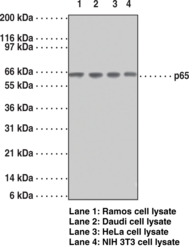
NF-κB p65 is a ubiquitously expressed transcription factor that is a subunit of the NF-κB complex and is encoded by the RELA gene in humans.1 It is composed of an N-terminal Rel homology domain, which contains the nuclear localization signal (NLS), and mediates dimerization, nuclear localization, and DNA and protein interactions, and two C-terminal transactivation domains that are subject to a variety of post-translational modifications and regulate the transcriptional activity of p65.1,2 NF-κB p65 regulates the expression of a large number of genes in response to inflammatory and environmental cues that play critical roles in innate and adaptive immunity and cellular differentiation.2 Silencing of Rela induces tumor cell apoptosis in a murine Lewis lung carcinoma model, and RELA silencing in THP-1 monocytes decreases secreted levels of IL-1β and TNF-α induced by LPS.3,4 Genome-wide deletion of Rela in mice is embryonic lethal.5 NF-κB p65 is overexpressed in the inflamed joints of patients with rheumatoid arthritis, and naïve CD4 T cells isolated from the whole blood of patients with multiple sclerosis have increased phosphorylation of NF-κB p65.6,7 Cayman’s NF-κB (p65) Monoclonal Antibody (Clone 112A1021) can be used for flow cytometry (FC), immunohistochemistry (IHC), and Western blot (WB) applications. The antibody recognizes NF-κB (p65) from human, mouse, and rat samples.
WARNING This product is not for human or veterinary use.
References & Product Citations
1. NF-
2. Mechanisms of NF-
3. Knockdown of NF-
4. siRNA directed against NF‑κB inhibits mononuclear macrophage cells releasing proinflammatory cytokines in vitro. Mol. Med. Rep. 16(6), 9060-9066 (2017).
5. An essential role for NF-
6. NF-
7. Genetic variants associated with autoimmunity drive NFκB signaling and responses to inflammatory stimuli. Sci. Transl. Med. 7(291), 291ra293 (2015).
Contact Info
Cayman Chemical1180 East Ellsworth RoadAnn Arbor, Michigan 48108 USAToll Free: (800) 364-9897(USA and Canada only)Fax: (734) 971-3640


