
Technical Support & Resources
Visit our FAQ
Contact Us
Toll Free Phone (USA and Canada Only): (888) 526-5351
Direct Phone: (734) 975-3888
Product Categories
Technical Information
- 12-(S)-hydroxy-5,8,10,14-Eicosatetraenoic Acid Receptor
- G Protein-Coupled Receptor 31
- 12-HETER
- 12(S)-HETE Receptor
Shipping & Storage Information
Recommended Products
Certificates of Analysis & Batch Specific Data
Provide batch numbers separated by commas to download or request available product inserts, QC sheets, certificates of analysis, data packs, and GC-MS data.

Visit Our Cancer Resource Center
Find Tools & Resources to Study the Hallmarks of Cancer
- Cancer cell signaling & regulation
- Cancer metabolism
- Tumor microenvironment
Product Description
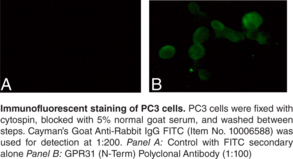
GPR31, also known as the 12(S)-HETE receptor (12-HETER), is a G protein-coupled receptor that is coupled to the Gi signal transduction pathway and activated by 12(S)-HETE (Item No. 34570), a metabolite of arachidonic acid (Item Nos. 90010 | 90010.1 | 10006607).1,2 It is expressed by platelets and localizes to the plasma membrane and endoplasmic reticulum.1,3 siRNA knockdown of GPR31 inhibits 12(S)-HETE-induced tumor cell invasion in vitro, and Gpr31 knockdown in murine Hepa1-6 cells reduces tumorigenesis of those cells in a mouse model of hepatocellular carcinoma recurrence after hepatic ischemia-reperfusion injury.2,4 It is overexpressed in prostate cancer tumors and positively correlated with tumor grade.5 Cayman's GPR31 (N-Term) Polyclonal Antibody can be used for Western blot (WB), ELISA, flow cytometry (FC), and immunofluorescence (IF) applications. The antibody recognizes the N-terminal region of GPR31 from human samples.
WARNING This product is not for human or veterinary use.
References & Product Citations
1. Lipid receptor GPR31 (G-
2. Identification of the orphan G protein-
3. Targeting RAS -
4. Ischemia reperfusion injury promotes recurrence of hepatocellular carcinoma in fatty liver via ALOX12-
5. 12-
Contact Info
Cayman Chemical1180 East Ellsworth RoadAnn Arbor, Michigan 48108 USAToll Free: (800) 364-9897(USA and Canada only)Fax: (734) 971-3640


