
Active, pure human recombinant enzyme
Technical Support & Resources

Visit our FAQ

Contact Us

Toll Free Phone (USA and Canada Only): (888) 526-5351
Direct Phone: (734) 975-3888

Request Technical Support

Technical Support Request

To streamline the process attach the appropriate questionnaire to your inquiry.

Download IHC QuestionnaireDownload WB Questionnaire

View Our Privacy Statement for details on how we use and protect your data. In addition, this site is protected by hCaptcha and its Privacy Policy and Terms of Service apply.

IDH1 (R132H mutant; human, recombinant)

Item No. 14132
Technical Information
Synonyms
  • Isocitrate Dehydrogenase (NADP) Cytoplasmic
Purity
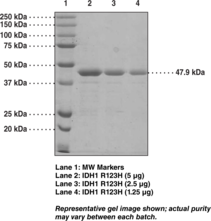
≥95% estimated by SDS-PAGE
Source
Active recombinant C-terminal His-tagged protein expressed in E. coli
Amino Acids
2-414 (full-length)
MW
47.9 kDa
50 mM Tris-HCl, pH 7.5, containing 200 mM sodium chloride, 5 mM β-mercaptoethanol, and 10% glycerol
UniProt Accession №
O75874
Shipping & Storage Information
Storage
-80°C
Shipping
Dry ice in continental US; may vary elsewhere
Recommended Products

Certificates of Analysis & Batch Specific Data

Provide batch numbers separated by commas to download or request available product inserts, QC sheets, certificates of analysis, data packs, and GC-MS data.

    Add

    Cayman Chemical
    Visit Our Cancer Resource Center
    Find Tools & Resources to Study the Hallmarks of Cancer
    • Cancer cell signaling & regulation
    • Cancer metabolism
    • Tumor microenvironment
    EXPLORE NOW
    Product Description

    Isocitrate dehydrogenases (IDHs) are NAD+ and NADP+-dependent enzymes that catalyze the third step of the tricarboxylic acid cycle. IDHs catalyze oxidative decarboxylation of isocitrate producing α-ketoglutarate (α-KG) and carbon dioxide. IDH1 (cytosolic) and IDH2 (mitochondrial) are NADP+-dependent enzymes that catalyze reversible reactions. The IDH3 isoform, a NAD+-dependent multisubunit enzyme, is irreversible and allosterically regulated by a variety of positive (calcium, ADP, and citrate) and negative (ATP, NADH, and NADPH) effectors.1 IDH1 and IDH2 are mutated in >70% of lower grade gliomas.2 The most common IDH mutation, Arg132His, imparts new gain of function catalytic activity leading to the NADPH-dependent conversion of α-KG to 2-hydroxyglutarate.3,4 Astrocytes expressing IDH1 R132H mutant have been shown to produce markedly increased levels of the R-2-hydroxyglutarate enantiomer, leading to transformation of cells through the HIF prolyl 4-hydroxylase, EGLN.5

    WARNING This product is not for human or veterinary use.

    References & Product Citations
    Product Description References

    1. Raimundo, N., Baysal, B.E., and Shadel, G.S. Revisiting the TCA cycle: Signaling to tumor formation. Trends Mol. Med. 17(11), 641-649 (2011).

    2. Turcan, S., Rohle, D., Goenka, A., et alIDH1 mutation is sufficient to establish the glioma hypermethylator phenotype. Nature 483(7390), 479-483 (2012).

    3. Reitman, Z.J., and Yan, H. Isocitrate dehydrogenase 1 and 2 mutations in cancer: Alterations at a crossroads of cellular metabolism. J. Natl. Cancer Inst. 102(13), 932-941 (2010).

    4. Dang, L., White, D.W., Gross, S., et alCancer-associated IDH1 mutations produce 2-hydroxyglutarate. Nature 462(7274), 739-744 (2009).

    5. Koivunen, P., Lee, S., Duncan, C.G., et alTransformation by the (R)-enantiomer of 2-hydroxyglutarate linked to EGLN activation. Nature 483(7390), 484-488 (2012).

