
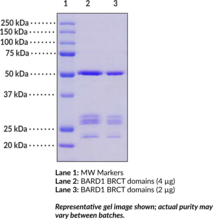
Pure human recombinant protein
Technical Support & Resources

Visit our FAQ

Contact Us

Toll Free Phone (USA and Canada Only): (888) 526-5351
Direct Phone: (734) 975-3888

Request Technical Support

Technical Support Request

To streamline the process attach the appropriate questionnaire to your inquiry.

Download IHC QuestionnaireDownload WB Questionnaire

View Our Privacy Statement for details on how we use and protect your data. In addition, this site is protected by hCaptcha and its Privacy Policy and Terms of Service apply.

Product Categories

Product Type

Application

BARD1 BRCT domains (human, recombinant)

Item No. 14166
Technical Information
Synonyms
  • BRCA1-Associated RING Domain Protein 1
Purity
≥60%
Source
Recombinant N-terminal GST-tagged protein expressed in E. coli
Amino Acids
554-777
MW
52.4 kDa
50 mM Tris, pH 8.0, with 150 mM sodium chloride and 20% glycerol
UniProt Accession №
Q99728
Shipping & Storage Information
Storage
-80°C
Shipping
Dry ice in continental US; may vary elsewhere
Recommended Products

Certificates of Analysis & Batch Specific Data

Provide batch numbers separated by commas to download or request available product inserts, QC sheets, certificates of analysis, data packs, and GC-MS data.

    Add

    Cayman Chemical
    Visit Our Cancer Resource Center
    Find Tools & Resources to Study the Hallmarks of Cancer
    • Cancer cell signaling & regulation
    • Cancer metabolism
    • Tumor microenvironment
    EXPLORE NOW
    Product Description

    BRCA1-associated RING domain protein 1 (BARD1) is a binding partner of the breast and ovarian tumor suppressor (BRCA1).1,2 BARD1 binding to BRCA1 via the RING and BRCT domains regulates BRCA1 stability, cellular localization, and function.2,3,4 Heterodimeric BRCA1/BARD1 enhances BRCA1 functions, including the maintenance of genomic stability by participating in DNA repair mechanisms.3 Further, BRCA1/BARD1 heterodimers have been shown to have ubiquitin ligase activity.5 BARD1 has also been shown to mediate p53-dependent, BRCA1-independent apoptosis.6,7 BARD1 binding to the mRNA polyadenylation factor, cleavage stimulation factor-50, is involved in inhibiting mRNA processing and tumor suppression.8,9 BARD1 contains two BRCA1 C-terminal (BRCT) domains.1 BRCT domains are modular units of ~100 amino acids that fold independently and recognize linear phosphoserine or phosphothreonine regions to mediate protein-protein and protein-DNA interactions.10,11 BRCT domains were initially recognized in the C-terminal region of the breast cancer protein BRCA1, as well as the p53 binding protein and the yeast cell cycle checkpoint protein RAD9.12 BRCT domains often occur as tandem repeats at the C-terminal end of several proteins that are functionally diverse.11 Most BRCT domain-containing proteins participate in DNA-damage checkpoint control or DNA-repair pathways, or both.13,12 Thus, BRCT domain-containing proteins likely participate in the cellular response to DNA damage. This recombinant protein product contains the first and second BRCT domains of BARD1.

    WARNING This product is not for human or veterinary use.

    References & Product Citations
    Product Description References

    1. Wu, L.C., Wang, Z.W., Tsan, J.T., et alIdentification of a RING protein that can interact in vivo with the BRCA1 gene product. Nat. Genet. 14(4), 430-440 (1996).

    2. Irminger-Finger, I., and Jefford, C.E. Is there more to BARD1 than BRCA1? Nat. Rev. Cancer 6(5), 382-391 (2006).

    3. Simons, A.M., Horwitz, A.A., Starita, L.M., et alBRCA1 DNA-binding activity is stimulated by BARD1. Cancer Res. 66(4), 2012-2018 (2006).

    4. Baer, R., and Ludwig, T. The BRCA1/BARD1 heterodimer, a tumor suppressor complex with ubiquitin E3 ligase activity. Curr. Opin. Genet. Dev. 12(1), 86-91 (2002).

    5. Brzovic, P.S., Keeffe, J.R., Nishikawa, H., et alBinding and recognition in the assembly of an active BRCA1/BARD1 ubiquitin-ligase complex. Proc. Natl. Acad. Sci. USA 100(10), 5646-5651 (2003).

    6. Feki, A., Jefford, C.E., Berardi, P., et alBARD1 induces apoptosis by catalysing phosphorylation of p53 by DNA-damage response kinase. Oncogene 24(23), 3726-3736 (2005).

    7. Irminger-Finger, I., Leung, W.C., Li, J., et alIdentification of BARD1 as mediator between proapoptotic stress and p53-dependent apoptosis. Mol. Cell 8(6), 1255-1266 (2001).

    8. Irminger-Finger, I., and Leung, W.C. BRCA1-dependent and independent functions of BARD1. Int. J. Biochem. Cell Biol. 34(6), 582-587 (2014).

    9. Kleiman, F.E., and Manley, J.L. Functional interaction of BRCA1-associated BARD1 with polyadenylation factor CstF-50. Science 285(5433), 1576-1579 (1999).

    10. Manke, I.A., Lowery, D.M., Nguyen, A., et alBRCT repeats as phosphopeptide-binding modules involved in protein targeting. Science 302(5645), 636-639 (2003).

    11. Woods, N.T., Mesquita, R.D., Sweet, M., et alCharting the landscape of tandem BRCT domain-mediated protein interactions. Sci. Signal. 5(242), rs6 (2012).

    12. Bork, P., Hofmann, K., Bucher, P., et alA superfamily of conserved domains in DNA damage-responsive cell cycle checkpoint proteins. FASEB J. 11(1), 68-76 (1997).

    13. Callebaut, I., and Mornon, J.P. From BRCA1 to RAP1: A widespread BRCT module closely associated with DNA repair. FEBS Lett. 400(1), 25-30 (1997).

