Pure human recombinant protein
Technical Support & Resources

Visit our FAQ

Contact Us

Toll Free Phone (USA and Canada Only): (888) 526-5351
Direct Phone: (734) 975-3888

Request Technical Support

Technical Support Request

To streamline the process attach the appropriate questionnaire to your inquiry.

Download IHC QuestionnaireDownload WB Questionnaire

View Our Privacy Statement for details on how we use and protect your data. In addition, this site is protected by hCaptcha and its Privacy Policy and Terms of Service apply.

Product Categories

Product Type

BRCA1 BRCT domains (human, recombinant)

Item No. 14167
Technical Information
Synonyms
  • Breast Cancer Type 1 Susceptibility Protein
Purity
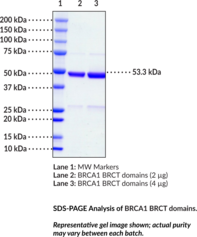
≥90% (estimated by SDS-PAGE)
Source
Recombinant N-terminal GST-tagged protein expressed in E. coli
MW
53.3 kDa
50 mM Tris-HCl, pH 8.0, with 150 mM sodium chloride, and 20% glycerol
UniProt Accession №
P38398
Shipping & Storage Information
Storage
-80°C
Shipping
Dry ice in continental US; may vary elsewhere
Recommended Products

Certificates of Analysis & Batch Specific Data

Provide batch numbers separated by commas to download or request available product inserts, QC sheets, certificates of analysis, data packs, and GC-MS data.

    Add

    Cayman Chemical
    Visit Our Cancer Resource Center
    Find Tools & Resources to Study the Hallmarks of Cancer
    • Cancer cell signaling & regulation
    • Cancer metabolism
    • Tumor microenvironment
    EXPLORE NOW
    Product Description

    The BRCA1 C-terminal (BRCT) domain is a modular unit of ~100 amino acids that folds independently and recognizes linear phosphoserine or phosphothreonine regions to mediate protein-protein and protein-DNA interactions.1,2 BRCT domains were initially recognized in the C-terminal region of the breast cancer protein BRCA1, as well as the p53 binding protein (53BP1; TP53BP1), and the yeast cell cycle checkpoint protein RAD9.3 BRCT domains often occur as tandem repeats at the C-terminal end of several proteins that are functionally diverse.2 Most BRCT domain-containing proteins participate in DNA-damage checkpoint control or DNA-repair pathways, or both.4,3 Thus, BRCT domain-containing proteins likely participate in the cellular response to DNA damage. Germ-line mutations of the tumor suppressor genes BRCA1 and BRCA2 pre-dispose women to familial breast and ovarian cancer and are associated with approximately 10% of the cases.5,6 The carboxy-terminal BRCT domain in BRCA1 is involved in DNA repair and transcriptional activation.7,8,6 The BRCT region of BRCA1 binds phosphorylated BACH1, a DEAH helicase, which is essential for mediating repair of DNA double-strand breaks by controlling G2 to M phase transition during cell cycle progression.9,10,11 BRCA1 also contains an N-terminal protein-protein-interaction RING-finger domain, that partners with BRCA1-associated RING domain 1 (BARD1).12 The BRCA1/BARD1 heterodimer maintains genomic stability by regulating DNA damage repair and ubiquitination.13 This product contains the BRCT domains of BRCA1.

    WARNING This product is not for human or veterinary use.

    References & Product Citations
    Product Description References

    1. Manke, I.A., Lowery, D.M., Nguyen, A., et al. BRCT repeats as phosphopeptide-binding modules involved in protein targeting. Science 302(5645), 636-639 (2003).

    2. Woods, N.T., Mesquita, R.D., Sweet, M., et al. Charting the landscape of tandem BRCT domain-mediated protein interactions. Sci. Signal. 5(242), rs6 (2012).

    3. Bork, P., Hofmann, K., Bucher, P., et al. A superfamily of conserved domains in DNA damage-responsive cell cycle checkpoint proteins. The FASEB Journal 11(1), 68-76 (1997).

    4. Callebaut, I., and Mornon, J.P. From BRCA1 to RAP1: A widespread BRCT module closely associated with DNA repair. FEBS Lett. 400(1), 25-30 (1997).

    5. O'Donovan, P.J., and Livingston, D.M. BRCA1 and BRCA2: Breast/ovarian cancer susceptibility gene products and participants in DNA double-strand break repair. Carcinogenesis 31(6), 961-967 (2010).

    6. Yarden, R.I., and Papa, M.Z. BRCA1 at the crossroad of multiple cellular pathways: Approaches for therapeutic interventions. Mol. Cancer Ther. 5(6), 1396-1404 (2006).

    7. Metcalfe, K.A., and Narod, S.A. Breast cancer prevention in women with a BRCA1 or BRCA2 mutation. Open Med. 1(3), e184-e190 (2007).

    8. Narod, S.A. Modifiers of risk of hereditary breast and ovarian cancer. Oncogene 25(43), 5832-5836 (2006).

    9. Shiozaki, E.N., Gu, L., Yan, N., et al. Structure of the BRCT repeats of BRCA1 bound to a BACH1 phosphopeptide: Implications for signaling. Mol. Cell 14(3), 405-412 (2004).

    10. Cantor, S.B., Bell, D.W., Ganesan, S., et al. BACH1, a novel helicase-like protein, interacts directly with BRCA1 and contributes to its DNA repair function. Cell 105(1), 149-160 (2001).

    11. Yu, W., Chini, C.C.S., He, M., et al. The BRCT domain is a phospho-protein binding domain. Science 302(5645), 639-642 (2003).

    12. Nishikawa, H., Wu, W., Koike, A., et al. BRCA1-associated protein 1 interferes with BRCA1/BARD1 RING heterodimer activity. Cancer Res. 69(1), 111-119 (2009).

    13. Brzovic, P.S., Keeffe, J.R., Nishikawa, H., et al. Binding and recognition in the assembly of an active BRCA1/BARD1 ubiquitin-ligase complex. Proc. Natl. Acad. Sci. USA 100(10), 5646-5651 (2003).