
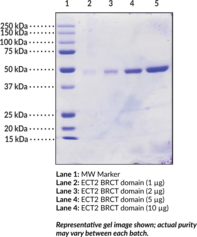
AA: 161-361 (partial protein) • Tag: N-terminal GST • MW: 50.2 kDa
Features
  • Due to limited shelf life and/or restricted production, this product is available as custom order only. Please contact our sales office for pricing and lead time.
Technical Support & Resources

Visit our FAQ

Contact Us

Toll Free Phone (USA and Canada Only): (888) 526-5351
Direct Phone: (734) 975-3888

Request Technical Support

Technical Support Request

To streamline the process attach the appropriate questionnaire to your inquiry.

Download IHC QuestionnaireDownload WB Questionnaire

View Our Privacy Statement for details on how we use and protect your data. In addition, this site is protected by hCaptcha and its Privacy Policy and Terms of Service apply.

ECT2 BRCT domains (human, recombinant)

Item No. 14168
Technical Information
Synonyms
  • Epithelial Cell-transforming Sequence 2 Oncogene
Purity
≥90%
Source
Recombinant N-terminal GST-tagged protein expressed in E. coli
Amino Acids
161-361 (partial protein)
MW
50.2 kDa
50 mM Tris, pH 7.5, with 500 mM sodium chloride, 5% glycerol, and 5 mM β-mercaptoethanol
Shipping & Storage Information
Storage
-80°C
Shipping
Dry ice in continental US; may vary elsewhere
Recommended Products

Certificates of Analysis & Batch Specific Data

Provide batch numbers separated by commas to download or request available product inserts, QC sheets, certificates of analysis, data packs, and GC-MS data.

    Add

    Cayman Chemical
    Visit Our Cancer Resource Center
    Find Tools & Resources to Study the Hallmarks of Cancer
    • Cancer cell signaling & regulation
    • Cancer metabolism
    • Tumor microenvironment
    EXPLORE NOW
    Product Description

    Epithelial cell-transforming sequence 2 oncogene (ECT2) is a guanine nucleotide exchange factor (GEF) that catalyzes the exchange of GDP for GTP from small GTPases of the Rho family, such as RhoA, RhoC, Rac1, and Cdc42.1 ECT2 GEF activity plays an essential role during cytokinesis.2 ECT2 contains a DH (DBL-homology) domain, a pleckstrin homology (PH) domain and tandem BRCT domains.3 BRCT domains are modular units of ~100 amino acids that fold independently and recognize linear phosphoserine or phosphothreonine regions to mediate protein-protein and protein-DNA interactions.4,5 BRCT domains were initially recognized in the C-terminal region of the breast cancer protein BRCA1, as well as the p53 binding protein and the yeast cell cycle checkpoint protein RAD9.6 BRCT domains often occur as tandem repeats at the C-terminal end of several proteins that are functionally diverse.5 Most BRCT domain-containing proteins participate in DNA-damage checkpoint control or DNA-repair pathways, or both.7,6 The BRCT domains of ECT2 make intramolecular interactions with the C-terminal DH/PH domains of the protein, thus, masking the catalytic GEF activity for Rho GTPases.8 Additionally, release of the autoinhibition by the BRCT domains may be necessary for the proper functioning of ECT2 during cytokinesis.8 Expression levels of ECT have been shown to be strongly correlated with prognosis in glioma patients.9

    WARNING This product is not for human or veterinary use.

    References & Product Citations
    Product Description References

    1. Miki, T., Smith, C.L., Long, J.E., et al. Oncogene ect2 is related to regulators of small GTP-binding proteins. Nature 362(6419), 462-465 (1993).

    2. Kimura, K., Tsuji, T., Takada, Y., et al. Accumulation of GTP-bound RhoA during cytokinesis and a critical role of ECT2 in this accumulation. The Journal of Biological Chemisty 275(23), 17233-17236 (2000).

    3. Fields, A.P., and Justilien, V. The guanine nucleotide exchange factor (GEF) Ect2 is an oncogene in human cancer. Adv. Enzyme Regul. 50(1), 190-200 (2010).

    4. Manke, I.A., Lowery, D.M., Nguyen, A., et al. BRCT repeats as phosphopeptide-binding modules involved in protein targeting. Science 302(5645), 636-639 (2003).

    5. Woods, N.T., Mesquita, R.D., Sweet, M., et al. Charting the landscape of tandem BRCT domain-mediated protein interactions. Sci. Signal. 5(242), rs6 (2012).

    6. Bork, P., Hofmann, K., Bucher, P., et al. A superfamily of conserved domains in DNA damage-responsive cell cycle checkpoint proteins. The FASEB Journal 11(1), 68-76 (1997).

    7. Callebaut, I., and Mornon, J.P. From BRCA1 to RAP1: A widespread BRCT module closely associated with DNA repair. FEBS Lett. 400(1), 25-30 (1997).

    8. Kim, J.E., Billadeau, D.D., and Chen, J. The tandem BRCT domains of ect2 are required for both negative and positive regulation of ect2 in cytokinesis. The Journal of Biological Chemisty 280(7), 55733-55739 (2005).

    9. Sano, M., Genkai, N., Yajima, N., et al. Expression level of ECT2 proto-oncogene correlates with prognosis in glioma patients. Oncol. Rep. 16(5), 1093-1098 (2006).

