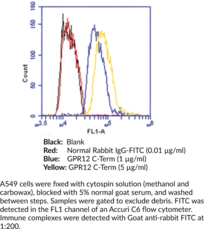
For immunochemical detection of GPR12
Technical Support & Resources

Visit our FAQ

Contact Us

Toll Free Phone (USA and Canada Only): (888) 526-5351
Direct Phone: (734) 975-3888

Request Technical Support

Technical Support Request

To streamline the process attach the appropriate questionnaire to your inquiry.

Download IHC QuestionnaireDownload WB Questionnaire

View Our Privacy Statement for details on how we use and protect your data. In addition, this site is protected by hCaptcha and its Privacy Policy and Terms of Service apply.

GPR12 (C-Term) Polyclonal Antibody

Item No. 14266

Technical Information
Synonyms
  • G Protein-Coupled Receptor 12
Immunogen
Synthetic peptide from the C-terminal region of human GPR12
Peptide affinity-purified polyclonal antibody
Storage Buffer
TBS, pH 7.4 when reconstituted in 500 µl deionized water
Host
Rabbit
Applications
FC and ICC
Species Reactivity
(+) Human GPR12 receptor
UniProt Accession №
P47775
Shipping & Storage Information
Storage
-20°C
Shipping
Wet ice in continental US; may vary elsewhere
Recommended Products

Certificates of Analysis & Batch Specific Data

Provide batch numbers separated by commas to download or request available product inserts, QC sheets, certificates of analysis, data packs, and GC-MS data.

    Add

    Product Description

    G protein-coupled receptor 12 (GPR12) is a high affinity receptor for sphingosine-1-phosphate, sphingosyl-phosphorylcholine and tyrosol that is expressed in brain, pituitary, ovary, and testis tissues.1,2,3,4,5 GPR12 plays a role in neuronal differentiation, neuronal growth and the formation of synaptic contacts.5,2 Cayman’s GPR12 receptor (C-Term) polyclonal antibody can be used for flow cytometry and immunocytochemistry of GPR12 on human samples.

    WARNING This product is not for human or veterinary use.

    References & Product Citations
    Product Description References

    1. Uhlenbrock, K., Gassenhuber, H., and Kostenis, E. Sphingosine 1-phosphate is a ligand of the human gpr3, gpr6 and gpr12 family of constitutively active G protein-coupled receptors. Cell. Signal. 14(11), 941-953 (2002).

    2. Ignatov, A., Lintzel, J., Hermans-Borgmeyer, I., et alRole of the G-protein-coupled receptor GPR12 as high-affinity receptor for sphingosylphosphorylcholine and its expression and function in brain development. J. Neurosci. 23(3), 907-914 (2003).

    3. Lin, Z.J., Lu, X.M., Zhu, T.J., et alGPR12 selections of the metabolites from an endophytic Streptomyces sp. associated with Cistanches deserticola. Arch. Pharm. Res. 31(9), 1108-1114 (2008).

    4. Eidne, K.A., Zabavnik, J., Peters, T., et alCloning, sequencing and tissue distribution of a candidate G protein-coupled receptor from rat pituitary gland. FEBS Lett. 292(1-2), 243-248 (1991).

    5. Tanaka, S., Ishii, K., Kasai, K., et alNeural expression of G protein-coupled receptors GPR3, GPR6, and GPR12 up-regulates cyclic AMP levels and promotes neurite outgrowth. The Journal of Biological Chemisty 282(14), 10506-10515 (2007).