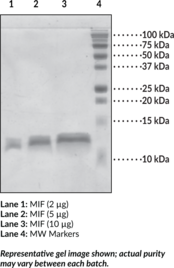
Active, pure human recombinant enzyme
Technical Support & Resources

Visit our FAQ

Contact Us

Toll Free Phone (USA and Canada Only): (888) 526-5351
Direct Phone: (734) 975-3888

Request Technical Support

Technical Support Request

To streamline the process attach the appropriate questionnaire to your inquiry.

Download IHC QuestionnaireDownload WB Questionnaire

View Our Privacy Statement for details on how we use and protect your data. In addition, this site is protected by hCaptcha and its Privacy Policy and Terms of Service apply.

MIF (human, recombinant)

Item No. 14493

Technical Information
Synonyms
  • Macrophage Migration Inhibitory Factor
Purity
≥95% estimated by SDS-PAGE
Source
Recombinant human MIF expressed in E. coli
MW
12.6 kDa
50 mM Tris pH 7.5, 150 mM sodium chloride
UniProt Accession №
P14174
Shipping & Storage Information
Storage
-80°C
Shipping
Dry ice in continental US; may vary elsewhere
Recommended Products

Certificates of Analysis & Batch Specific Data

Provide batch numbers separated by commas to download or request available product inserts, QC sheets, certificates of analysis, data packs, and GC-MS data.

    Add

    Cayman Chemical
    Visit Our Cancer Resource Center
    Find Tools & Resources to Study the Hallmarks of Cancer
    • Cancer cell signaling & regulation
    • Cancer metabolism
    • Tumor microenvironment
    EXPLORE NOW
    Product Description

    Macrophage Migration Inhibitory Factor (MIF) is a small, pro-inflammatory cytokine. MIF signaling is important in septic shock, arthritis, colitis, and cardiovascular diseases.1 MIF counteracts glucocorticoid signaling, which would otherwise inhibit inflammation. Secreted MIF binds to CD74 receptors, which then couple to CD44, during monocyte recruitment.2 In addition to CD44 binding, MIF is an enzymatically active keto-enol tautomerase that is inhibited by isothiocyanates such as sulforaphane.3 Overexpression of MIF has been seen in several cancers. MIF overexpression has been shown to promote hypoxia induced HIF-1α stabilization leading to changes in the tumor microenvironment, including stimulation of angiogenesis and neovascularization.4

    WARNING This product is not for human or veterinary use.

    References & Product Citations
    Product Description References

    1. Zernecke, A., Bernhagen, J., and Weber, C. Macrophage migration inhibitory factor in cardiovascular disease. Circulation 117(12), 1594-1602 (2008).

    2. Leng, L., and Bucala, R. Insight into the biology of macrophage migration inhibitory factor (MIF) revealed by the cloning of its cell surface receptor. Cell Res. 16(2), 162-168 (2006).

    3. Healy, Z.R., Liu, H., Holtzclaw, W.D., et alInactivation of tautomerase activity of macrophage migration inhibitory factor by sulforaphane: A potential biomarker for anti-inflammatory intervention. Cancer Epidemiol. Biomarkers Prev. 20(7), 1516-1523 (2011).

    4. Rendon, B.E., Willer, S.S., Zundel, W., et alMechanisms of macrophage migration inhibitory factor (MIF)-dependent tumor microenvironmental adaptation. Exp. Mol. Pathol. 86(3), 180-185 (2009).