
Technical Support & Resources
Visit our FAQ
Contact Us
Toll Free Phone (USA and Canada Only): (888) 526-5351
Direct Phone: (734) 975-3888
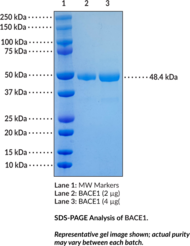
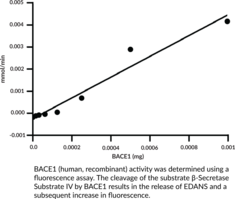
Technical Information
- β-site Amyloid Precursor Protein Cleaving Enzyme 1
- ASP-2
- BACE
- Memapsin 2
- Membrane-bound Aspartic Protease
- β-secretase 1
Shipping & Storage Information
Recommended Products
Certificates of Analysis & Batch Specific Data
Provide batch numbers separated by commas to download or request available product inserts, QC sheets, certificates of analysis, data packs, and GC-MS data.
Product Description
β-Secretase 1 (BACE1) is an aspartic protease and member of the peptidase A1 protease family.1 BACE1 is transcribed as a preprotein composed of an N-terminal signal peptide, a pro-peptide, a catalytic domain, a transmembrane domain, and a cytosolic domain. The N-terminal signal peptide traffics the BACE1 preprotein to the endoplasmic reticulum where furin-mediated cleavage of the propeptide produces mature BACE1. The transmembrane domain of mature BACE1 drives localization to the Golgi where BACE1 is post-translationally activated and functions at endosomal or Golgi membranes.1,2 BACE1 is expressed primarily in the brain and at lower levels in pancreatic β-cells, adipocytes, hepatocytes, and vascular cells. BACE1 cleaves amyloid precursor protein (APP) to initiate the generation of amyloid-β (Aβ), and BACE1 knockout rescues memory deficits and cholinergic dysfunction in transgenic mouse models of Alzheimer's disease.3,4 Additional BACE1 substrates include seizure-related 6 (SEZ6) and seizure-related 6-like (SEZ6L), and BACE1-mediated cleavage of Sez6 and Sez6L is increased in the brain in a mouse model of Niemann-Pick type C disease.5 Cayman's BACE1 (human, recombinant) protein can be used for enzyme activity assays.
WARNING This product is not for human or veterinary use.
References & Product Citations
1. BACE1: More than just a β-
2. Post-
3. Inhibiting BACE1 to reverse synaptic dysfunctions in Alzheimer’s disease. Neurosci. Biobehav. Rev. 65, 326-340 (2016).
4. Biochemical and cell-
5. BACE1-
Contact Info
Cayman Chemical1180 East Ellsworth RoadAnn Arbor, Michigan 48108 USAToll Free: (800) 364-9897(USA and Canada only)Fax: (734) 971-3640


