
A competitive 15-hydroxy PGDH inhibitor
Technical Support & Resources

Visit our FAQ

Contact Us

Toll Free Phone (USA and Canada Only): (888) 526-5351
Direct Phone: (734) 975-3888
Request Technical Support

Technical Support Request

To streamline the process attach the appropriate questionnaire to your inquiry.

Download IHC QuestionnaireDownload WB Questionnaire

View Our Privacy Statement for details on how we use and protect your data. In addition, this site is protected by hCaptcha and its Privacy Policy and Terms of Service apply.

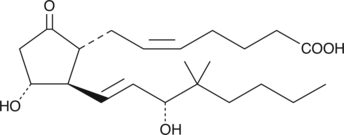
16,16-dimethyl Prostaglandin E2

Item No. 14750

Technical Information
Formal Name
9-oxo-11α,15R-dihydroxy-16,16-dimethyl-prosta-5Z,13E-dien-1-oic acid
CAS Number
39746-25-3
Synonyms
  • 16,16-dimethyl PGE2
Molecular Formula
C22H36O5
Formula Weight
Purity
≥95%
Formulation
A 10 mg/ml solution in methyl acetate
DMF: >100 mg/ml (from PGE2)DMSO: >100 mg/ml (from PGE2)Ethanol: >100 mg/ml (from PGE2)PBS pH 7.2: >5 mg/ml (from PGE2)
SMILES
O=C1[C@H](C/C=C\CCCC(O)=O)[C@@H](/C=C/[C@@H](O)C(C)(C)CCCC)[C@H](O)C1
InChi Code
InChI=1S/C22H36O5/c1-4-5-14-22(2,3)20(25)13-12-17-16(18(23)15-19(17)24)10-8-6-7-9-11-21(26)27/h6,8,12-13,16-17,19-20,24-25H,4-5,7,9-11,14-15H2,1-3H3,(H,26,27)/b8-6-,13-12+/t16-,17-,19-,20-/m1/s1
InChi Key
QAOBBBBDJSWHMU-WMBBNPMCSA-N
Shipping & Storage Information
Storage
-20°C
Shipping
Wet ice in continental US; may vary elsewhere
Recommended Products

Certificates of Analysis & Batch Specific Data

Provide batch numbers separated by commas to download or request available product inserts, QC sheets, certificates of analysis, data packs, and GC-MS data.

    Add

    Add

    Add

    Lipid Resource Center
    Discover Products & Resources for Lipid Research
    • High-purity lipid standards
    • Lipid roles in biology
    • Lipids in health & disease
    • Lipids for pharmaceutical development
    • Protocols, advice, & resources
    EXPLORE NOW
    Product Description

    16,16-dimethyl PGE2 is a competitive inhibitor of 15-hydroxy PGDH, but it is not a substrate for the enzyme.1 Because of its resistance to metabolism by 15-hydroxy PGDH, it has a prolonged half-life in vivo. 16,16-dimethyl PGE2 acts as an agonist on most EP receptor subtypes, and has been used experimentally to induce cervical ripening, uterine contraction, and prevent ulceration of the gastric mucosa in rats and dogs.2,3 The Kd for activation of isolated EP2 receptors is about 1 nM.3 16,16-dimethyl PGE2 can be used to preserve the self-renewal properties while preventing the differentiation of hematopoietic stem cells during expansion in culture.4,5

    WARNING This product is not for human or veterinary use.

    References & Product Citations
    Product Description References

    1. Ohno, H., Morikawa, Y., and Hirata, F. Studies on 15-hydroxyprostaglandin dehydrogenase with various prostaglandin analogues. J. Biochem. 84(6), 1485-1494 (1978).

    2. Robert, A., Schultz, J.R., Nezamis, J.E., et alGastric antisecretory and antiulcer properties of PGE2, 15-methyl PGE2, and 16,16-dimethyl PGE2. Intravenous, oral and intrajejunal administration. Gastroenterology 70(3), 359-370 (1976).

    3. Coleman, R.A., Smith, W.L., and Narumiya, S. International Union of Pharmacology classification of prostanoid receptors: Properties, distribution, and structure of the receptors and their subtypes. Pharmacol. Rev. 46(2), 205-229 (1994).

    4. Hagedorn, E.J., Durand, E.M., Fast, E.M., et alGetting more for your marrow: Boosting hematopoietic stem cell numbers with PGE2. Exp. Cell Res. (2014).

    5. Genovese, P., Schiroli, G., Escobar, G., et alTargeted genome editing in human repopulating haematopoietic stem cells. Nature 510(7504), 235-240 (2014).

    Product Citations

    Roulis, M., Kaklamanos, A., Schernthanner, M., et alParacrine orchestration of intestinal tumorigenesis by a mesenchymal niche. Nature 580(7804), 524-529 (2020).

    Roulis, M., Nikolaou, C., Kotsaki, E., et alIntestinal myofibroblast-specific Tpl2-Cox-2-PGE2 pathway links innate sensing to epithelial homeostasis. Proc. Natl. Acad. Sci. USA 111(43), E4658-E4667 (2014).

